Being an experienced mobile game development company, we are asked this question by every aspirational client like you. The reality is that there is no fixed timeframe for any type of app, and the same goes for mobile game development as well. On average, small and mid-tier games can take 6 months to 2 years, while AAA games can take longer. The exact timeline is determined by the type of game, level of complexity, and platform choice.
The game development industry has observed a notable hike in players’ expectations, technological advancements, and quality standards that led to an increase in the game development timeline. Unity’s 2024 Gaming Report stated that games now take approximately 304 days these days, compared to a few years ago when it used to take 218 days till the launch. Having a clear knowledge of the mobile game development timeline from the very start really helps in choosing the right development partner, avoiding delays, and budget planning that ensures a smooth game development process.
Understanding Game Development Timeline from Idea to Launch
The actual duration required for game development needs to be understood because it helps with both project management and development planning for successful game production. The mobile game development process consists of multiple stages, which we will review to assess their impact on the project timeline.
1. Pre-Production: Planning Before Development
- Define the game concept together with its boundaries and intended gaming platforms
- Determine which features to develop, which technologies to use, and which positions to fill with team members.
- Milestone establishment to create a path for its development.
Why it matters: Proper planning prevents delays, amendments in the project scope, and costly executions.
2. Production: Building the Game
- Tasks involve programming, creating assets, designing levels, and connecting different systems.
- Team experience and project complexity directly impact timelines
- The project remains on its planned timeline because milestones act as checkpoints for progress.
Why it matters: Production is the longest phase, and structured workflows prevent wasted time
3. Post-Launch: Updates and Optimization
- Bug fixes, performance enhancements, and the addition of new content.
- The development team uses player feedback to improve the gameplay experience
- Becomes essential for both mobile platforms and live-service games.
Why it matters: Post-launch work is part of the overall development timeframe and affects user retention
Why Structured Planning Is Key
The project stays on schedule through a complete project timeline, which schedules all stages from pre-production to post-launch while enabling better resource management and delivering superior outcomes.
What Is the Average Game Development Time Across the Industry?
The game development time varies accordingly for every project. For example, smaller games take a few months for completion, while complex titles can take years. Keeping yourself aware of these benchmarks is critical to set realistic budget, resources, and scheduling.
Industry Benchmarks and Averages
Based on industry trends, development timelines generally fall into these ranges (Zipdo):
- Indie/Small Games: 6–12 months
- Mid-Tier Games: 18–30 months
- AAA Games: 36–48 months
- Complex AAA Titles with Multiplayer/High-End Graphics: 5+ years
These figures create a reliable reference framework that enables better resource and schedule planning, thus assisting teams and businesses to improve their time estimation accuracy.
Why Average Game Development Time Varies Widely
Game development time is impacted by several factors, such as the type of game, platform selection, features, and technical complexity. Every additional feature, functionality, and animation adds to the time and game development cost. Sometimes, game developers extend the timeframe purposely to balance quality according to industry standards, which is why the game development time often varies.
First‑Time Studios vs Experienced Teams
Due to figuring out tools and refining workflows, a small indie game development studio takes longer and may need more testing and problem-solving when compared to an established and experienced mobile game development agency. That is because experienced developers have already defined pipelines, reusable assets, and better coordination that eventually help in reducing the development time.
How Long Does It Take to Develop Indie Games in Real-World Scenarios?
Indie games require developers to use multiple development approaches. The development timelines of a project depend on multiple constraints, which are team size, game scope, developer experience, and the tools used in development. Indie projects complete their development process faster than AAA titles, but they still need proper planning to prevent project delays and developer burnout.
Typical Indie Development Timelines
Most indie games fall into a broad but predictable range. The smaller games, which focus on specific mechanics, require short playtime to finish, whereas the larger indie games need much more time to complete.
- Simple indie games usually take 6 to 12 months
- Medium-scope indie games often require 12 to 24 months
- Ambitious indie projects can stretch to 2 to 3 years, especially with custom systems or rich content
These timelines assume the progression will be steady without substantial interruptions and major changes in scope.
Solo Developers vs Small Teams
When you’re a solo developer, projects just naturally take longer. That’s because you’re doing absolutely everything yourself – the design, the coding, the art, finding all the bugs, and making sure it all runs smoothly. The development process slows down quite a bit when even really skilled developers have to keep jumping between different tasks. It’s tough for them to maintain a good flow.
Small indie teams divide responsibilities among 3 to 10 individuals, which speeds up the development. Distribution of roles enhances efficiency, reduces errors, and enables parallel development. This is why, for a similar project, small teams usually provide better quality games in less time compared to solo developers.
Tools and Engines That Speed Up Production
Indie game developers have been the biggest time-savers, as great progress has also been made in engines and tools for game development. Game engines like Unity, Unreal Engine, and Godot do allow developers to make games faster, thanks to their complete physics, rendering, and asset management systems. Now it is faster to prototype and significantly better for making design changes. That’s because they leverage asset marketplaces, no-code plugins, and work around ready-made frameworks.
Choosing the correct tech stack and tools is very critical, as it keeps the system running smoothly and also reduces game development time.
So, How Long Does It Take to Develop Indie Games?
In real-world scenarios, it ranges between 6 months and 3 years to make an indie game, depending on scope, size of the project, team experience, and tools availability. The time it takes to create simple games is shorter than the time it takes to make super indie titles, with high-resolution graphics and rich storylines.
Having the right sense of the situation helps rationalize priorities and mitigate underestimation.
How Long Does It Take to Develop AAA Games Compared to Indie Projects?
AAA game development is just a different world from indie games. Bigger budgets, larger teams, and more demanding players extend the timeline from months to multiple years. For example, reports suggest that GTA 6 has been in development for several years, which shows that AAA projects require extended periods for their design, coding, and testing processes. The comparison shows why AAA projects maintain longer development periods while indie projects complete their work in shorter timeframes.
Typical AAA Game Development Timelines
AAA titles are long-term products with rigorously scheduled milestones and protracted production cycles.
- It takes 3 to 5 years to make most AAA games
- Big open world or live service games, they pretty much go north of 5 to 7 years
- The pre-production process itself could take 12-18 months before full production starts.
They go from concepts to modifications, asset creation, testing, and post-launch support planning.
Team Sizes and Parallel Workflows
To advance, the AAA studios have to scale. Teams can reach 200-500+ individuals across domains like gameplay, engine, art, animation, audio, QA, and live operations.
Parallel workflows help in constructing different aspects of the game at the same time. Although this accelerates execution, coordinate overheads also increase, resulting in additional time for approvals, feedback, and integrated testing.
Why AAA Games Take Years, Not Months
AAA titles strive for movie-quality graphics, huge worlds, intelligent AIs, and seamless multiplayer capabilities. All functionalities have to adhere to stringent performance and quality criteria in different environments.
Key Differences Between Indie and AAA Game Development Timelines
| Aspect | Indie Games | AAA Games |
| Development Time | 6 months to 3 years | 3 to 7+ years |
| Team Size | Solo developers or small teams (1–10) | Large teams (200–500+) |
| Scope | Focused mechanics and limited content | Expansive worlds and complex systems |
| Production Speed | Faster iteration and decision-making | Slower due to approvals and dependencies |
| Flexibility | High, can pivot quickly | Low, changes are costly |
| Post-Launch Support | Limited or optional | Long-term updates and live content |
In other words, indie development is about agility, while AAA development is about scale and shine.
Read this guide, “The Complete GTA 6 Development Cost Breakdown and Financial Analysis”, to have an idea of the AAA game project limits in terms of budget and timelines.
How Long Does It Take to Develop Mobile Games Compared to Indie and AAA Titles?
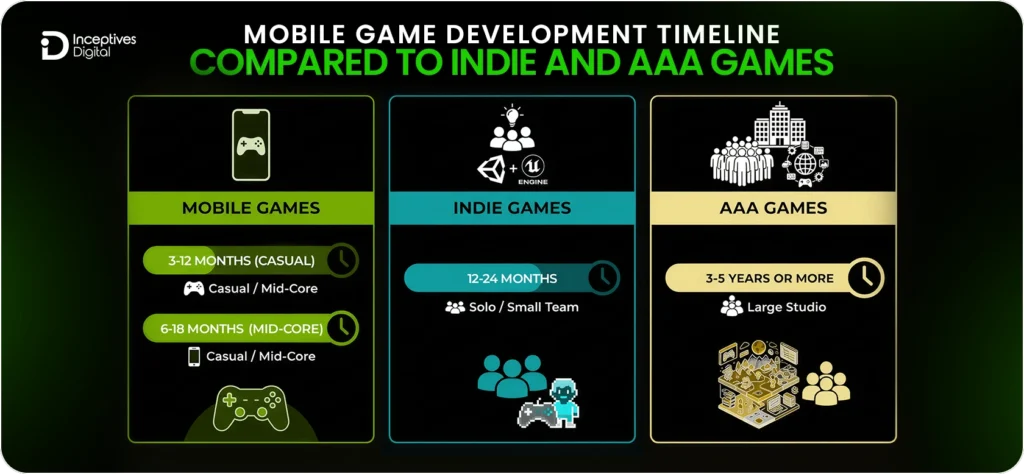
Mobile game development requires more time and resources than indie games, but less development work than AAA projects. The production process for mobile games takes less time than building AAA games, but their development duration matches that of independent games when the project includes extensive content, monetization methods, and the team needs to monitor the game after release.
Casual vs Mid-Core Mobile Games
The development process for mobile games varies because each game follows its own unique development path. Casual games focus on simplicity and fast engagement, while mid-core titles introduce deeper mechanics and progression systems.
Casual mobile games require a development period of 3 to 6 months when developers use established game mechanics, which include puzzle and hyper-casual gameplay. The development process for mid-core mobile games, which include strategy, RPG, and competitive multiplayer titles, needs between 9 and 18 months because developers must create additional components such as live events, progression systems, and backend technology.
Mobile vs Indie and AAA Game Development Timelines
Typically, mobile games need less development time when compared to AAA projects, but in some cases, they can overlap with indie projects.
The development timeline for Indie PC or console games ranges from 6 months to 3 years because of varying game development goals. The majority of mobile games operate between the lower and middle sections of this development schedule because developers use existing game engines and monetization systems. Games in the AAA category need much more time than mobile games because their production process lasts several years.
In practice, a mobile mid-core game may take no longer than a well-scoped indie game but still less time than any AAA project.
Platform-Specific Mobile Game Development Challenges
Game development faces time limitations because mobile platforms create restrictions during the development process. Games must operate without issues on various devices that have different screen dimensions and hardware specifications.
Performance optimization, battery usage, and touch-based UI design and device fragmentation create additional testing and iteration cycles. The need to support both iOS and Android platforms increases game development time unless there is proper management of the development process.
App Store Reviews and Post-Launch Cycles
Mobile games continue to receive updates after their initial launch, while PC and console games do not. App store review processes can delay releases, especially if guidelines are not met on the first submission.
Post-launch development continues with bug fixes, balance updates, new content, and monetization improvements. The majority of mobile games use live-update systems, which deliver new content to users every few weeks for user retention and competitive performance in app store rankings.
Key Factors Impacting the Timeframe of Game Development
The game development timeline depends on a limited number of essential decisions. The production process becomes more stable when the core elements of a project are established during its initial stages. The project experiences delays when team members fail to follow established protocols.
1. Game Genre and Gameplay Complexity
Small games with relatively basic mechanics are easier to develop because there’s less subsystem creation, testing, and balancing required. On the other hand, RPGs, strategy games, and multiplayer have progression systems, AI logic, a networking backend, and ongoing balancing. Every new mechanic means more development and testing time.
2. Target Platform and Device Requirements
Mobile games need to work on different screen dimensions, various OS versions, and diverse hardware specifications. PC and console games need performance enhancements, controller compatibility, and platform certification processes. The game development process becomes longer because testing and approval procedures take more time when a game needs to be tested on multiple platforms.
3. Game Engine and Technology Stack
Game engines that have been developed already offer built-in solutions for physics, rendering, and asset management. Teams can concentrate on creating their games because they do not need to develop fundamental technology. Custom engines and late technical changes create delays because they require extra time for setup, debugging, and maintenance tasks.
4. Team Experience and Communication
Teams that have more experience complete their work more quickly because they establish better plans, avoid doing unnecessary work, and maintain effective communication. The absence of proper communication leads to both ambiguous requirements and unnecessary work duplication, which results in project delays that extend beyond planned development timelines.
Why These Factors Matter Together
These factors do not work in isolation. A complex genre combined with multi-platform support and an inexperienced team can easily double a game development project’s timeline. Development progress can be maintained through clear planning, which extends to all four areas of the project.
Read this detailed Guide on “2D vs 3D Game Development” to understand how game dimension choice affects both the timeline and cost.
CTA SECTION START
cta title: Let our game developers team turn the ‘maybe’ into a ‘launch.
cta des: You’ve got the vision; we’ve got the experience to navigate the technical hurdles. Let’s combine forces to ensure your game hits the store exactly when you want it to.
cta button: Let’s Team Up
CTA SECTION END
What is a Game Design Document (GDD)?
A game design document lines the development process in measurable steps. It includes the game’s concept, mechanics, progression systems, requirement analysis, performance expectations, and the overall execution strategy. It is essential to lay down the foundation for a successful game development process. The timeline for a design document differs according to the game complexity, team size, and details required before production.
How Long Does It Take to Create a Game Design Document?
The development time for a GDD varies based on project scope:
- Small or casual games: 1–2 weeks
- Mid-sized games: 2–4 weeks
- Complex games (RPGs, multiplayer, live-service): 3–6+ weeks
More complex systems require additional planning, which includes necessary diagrams and validation procedures.
How Documentation Affects Game Development Time
Inadequate documentation delays game development because it lacks sufficient information. The team needs additional time to fix problems because they must resolve their misunderstandings, rebuild features, and correct their misaligned work. A well-developed GDD system protects development progress while reducing expensive future modifications.
How Much Time Is Required to Write the Code for a Video Game?
Suppose the code is the controller behind the puppets. Just as hidden strings put life in puppets, the code is behind every movement and interaction in the game. The design is made functional through robust backend systems, AI-powered decisions, and optimization. The coverage of so many areas makes it the most time-consuming phase of the game development process. Here are the main steps involved in the coding phase and the time each step takes:
1. Core Gameplay Logic
The core gameplay logic is often called the “core gameplay loop.” It covers the player behaviours like movements, combat progression, and basic interactions. For simple games, this phase can take 2 to 4 months, while complex games like AAA games can take up to 12 months or more.
2. Backend Systems and Multiplayer Code
The backend systems in games support the cloud infrastructure, player authentications, matchmaking, data retention, and in-game economies. The multiplayer code enables players to interact with each other in real time through two different methods, which use UDP for fast movement data synchronization and TCP for secure chat data transmission. Although multiplayer increases the complexity and the time. It usually takes 3 to 6 months or more, depending on the complexity.
3. AI, Physics, and Optimization
To enhance the gameplay experience, AI and Physics are used to provide a more personalized and realistic experience. The AI provides intelligent and dynamic NPC behaviour, making the experience personalized. Optimization of physics engines with simplified collision is utilized to develop immersive and responsive environments. These systems generally complete in 2 to 5 months or more if the behaviors or interactions are more advanced.
4. Debugging and Performance Tuning
Debugging and performance tuning are an important part of the game development process to make sure the game is secure, stable, efficient, and functions at a good frame rate on targeted devices. The best practices are to initiate early optimizations using profilers such as Unity Profiler, Unreal Insights, or NVIDIA Nsight to spot GPU/CPU bottlenecks and simplify complex problems. This phase usually takes 20 to 30% of the total coding process.
Coding Time Breakdown by Area
| Coding Area | Estimated Time Range |
| Core gameplay systems | 2–12 months |
| Backend and multiplayer | 3–6 months |
| AI and physics systems | 2–5 months |
| Debugging and optimization | 20–30% of total coding time |
How Long Does It Take to Create Sound Effects and Music for Video Games?
The right sound and music are crucial to make the performance immersive and engaging. A good audio engages and guides a player in every action, environment, and emotion. Because audio varies from custom compositions to adaptive soundtracks, careful implementation, it can take significant time. Here is how the audio production process impacts the modern game development timeline.
Audio’s Role and Types
The sounds in the game, such as footsteps, gunshots, environment sound effects, and the background music, really help players understand what’s going on and react naturally. Even the best gameplay can feel flat with bad audio, but a thoughtful sound design really makes things special.
Using stock sounds can save 1–2 weeks, while custom compositions may take 3–6+ weeks, depending on complexity. The implementation of adaptive or dynamic soundtracks, which react to gameplay elements, requires additional time because of their need for multiple integration processes.
Implementation and Testing
Audio integration work requires sound synchronization with both gameplay elements, animation sequences, and activation events. Music loops and transitions together with adaptive cues need precise configuration, which requires testing procedures. The typical duration for this stage lasts between 2 to 4 weeks, but the presence of interactive audio systems can prolong the duration beyond this period.
Audio Production Estimated Time Summary
| Audio Component | Estimated Time |
| Stock sound effects & music | 1–2 weeks |
| Custom compositions | 3–6+ weeks |
| Adaptive/dynamic soundtracks | Additional 2–4 weeks |
| Implementation & testing | 2–4 weeks |
What Is Development Hell and How Does It Disrupt Game Development Timelines
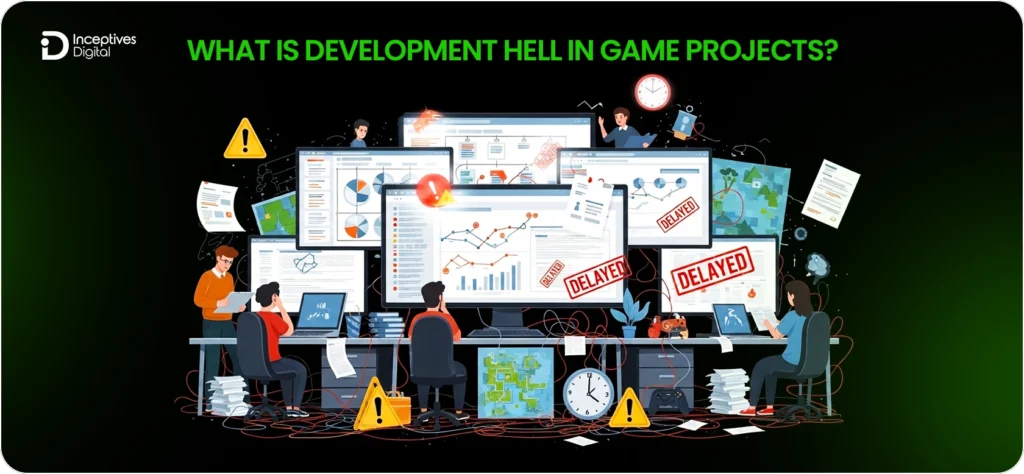
Development hell is a situation where a game development projects stocks or take years to develop due to mismanagement, constant iterations, or technical challenges. These situations can cause problems like endless iterations, budget overflowing, or even ending a project, declaring it as “vaporware”.
How Development Hell Disrupts Timelines
- Scope Creep: The project becomes unmanageable when new features are added without completing the current work.
- Endless Revisions: New directors, engines, and art direction changes cause teams to discard their work and start again
- Technical Challenges: Engine problems, difficult coding tasks, and technology that does not work together can freeze development for several months.
- Leadership & Financial Instability: Management changes and funding shortages create obstacles until all necessary resources become available.
- Overambitious Goals: High-detail graphics or massive open worlds can stretch the production far beyond the initial rough estimates.
Key Characteristics and Examples
Development hell creates disorganized games that experience multiple delays. The Duke Nukem Forever game took more than ten years to complete, which is a classic example of this situation. Development hell exists when teams work on design and initial project planning before they create their first stable product.
CTA SECTION START
cta title: We’ve seen games get stuck. We won’t let yours be one of them.
cta des: From scope creep to tech hurdles, we know where the traps are hidden. Let us handle the roadmap so you can focus on the fun stuff.
cta button: Protect Your Project
CTA SECTION END
How to Reduce Game Development Time Without Sacrificing Quality
There’s no need to rush or take shortcuts just to complete your game. If you plan things out, use good workflows, and come up with smart strategies. You can actually speed up your game development process and still have your game look great and keep players interested. When you really zone in on what’s important, move fast with your ideas, and make use of reusable assets, it truly helps you save time, lowers your worry, and keeps everything on the right path.
Key Tips For Reducing The Game Development Time:
- Smarter scope planning
- Agile workflows and iterative development
- Asset reuse and modular systems
- Early testing and feedback loops
- Clear milestone tracking
- Effective team communication
- Prioritizing critical features first
- Using proven tools and engines
Building an Efficient Game Development Team
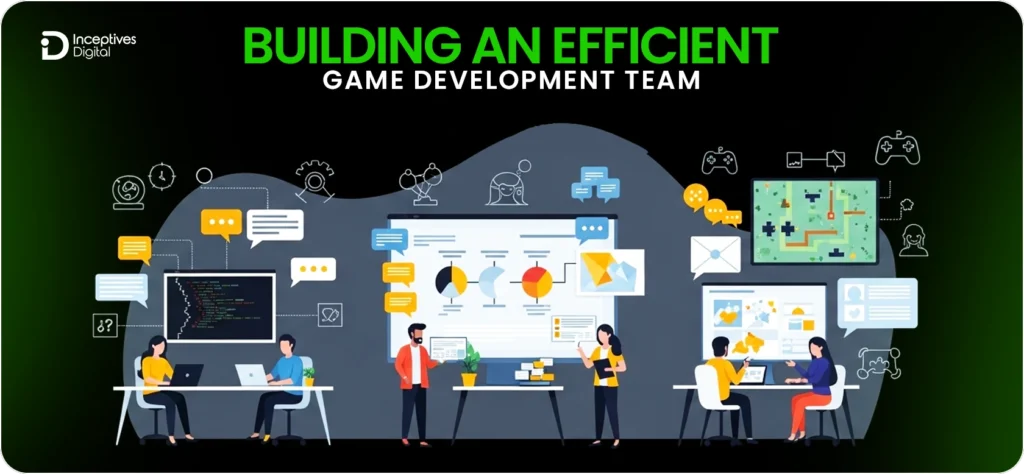
A good team is often the secret to getting a game out on time instead of it getting stuck in development hell. The best mobile game development companies focus on team configuration, roles, and communication straight from the start. Because the right combination speeds up the game development process.
Core Roles
Each development phase needs focused expertise. The game designers and technical leads create the mechanics, scope, and feasibility of the project during planning. The production process depends on programmers, artists, and animators who work simultaneously to achieve continuous progress. The QA engineers and live-ops teams verify performance, stability, and long-term support during the period close to product launch.
In-House vs Outsourced
The decision of hiring an in-house or outsourced team has a direct impact on the game development timeline, control, and cost. Most studios prefer a hybrid model that offers flexibility while protecting the core development.
| Team Model | Strengths | Limitations |
| In-house team | Strong ownership, faster decisions, deeper product knowledge | Higher long-term cost, slower to scale |
| Outsourced team | Faster production, flexible scaling, and cost efficiency | Requires strong management and documentation |
| Hybrid approach | Balance of control and speed | Needs clear coordination and workflows |
Communication Flow
Clear communication saves time at every stage of the game development process. Teams maintain their alignment through defined ownership, shared documentation, and regular synchronization meetings. When feedback loops follow structured patterns and teams use standardized tools, they achieve faster problem resolution while preventing delays that stem from team misalignment.
Final Thoughts: Setting Realistic Expectations for Game Development Time
So, game development timelines? A lot goes into them, like how big the game is, the technology you’re using, team size, and even every decision you make. There’s no one-size-fits-all answer for projects. It’s much better to think of timelines as flexible guides, not hard-and-fast commitments; that way, things usually turn out better. When expectations are fair and real, teams can actually focus on making things good, keeping them steady, and thinking about the long term instead of just scrambling to hit the deadlines. The right guidance can really make a big difference in your next game development project. Working with experienced individuals who offer mobile game development services benefits meeting timelines, realistic budget planning, and technical decisions from the very start. A well-planned approach saves time as well as ensures scalability, performance, and market competitiveness.
CTA SECTION START
cta title: Ready to stop calculating and start building?
cta des: You’ve seen the timelines, now it’s time to make it real. Let’s hop on a quick call and turn your ideas into a playable, polished game.
cta button: Start Your Game Today
CTA SECTION END
FAQs Regarding Game Development Timeframes
The development process for mobile games requires a time span of 3 to 12 months. The development process for casual games takes less time than mid-core and multiplayer games, which need extra time to develop their additional features, conduct testing, and build their backend systems.
The development time for games takes between 8 and 24 months, which varies according to the selected platform, the number of team members, and project difficulty. Indie games tend to be on the shorter end, while AAA titles often take several years.
Indie games typically take 6 months to 2 years. The development time for solo developers extends beyond 2 years, while experienced small teams can complete their work faster when they use modern engine technologies and reusable assets.
Coding and system integration take the longest to complete. Core gameplay logic, together with AI behavior, backend services, optimization, and bug fixing, needs continuous development work throughout the entire development process.
Yes. Clear scope definition, together with modular design, early testing, and agile workflows, enable projects to achieve their objectives while maintaining product quality and project stability.
SIDEBAR LIST START
- How Long Does it Take to Make a Mobile Game?
- Understanding Game Development Timeline from Idea to Launch
- What Is the Average Game Development Time Across the Industry?
- How Long Does It Take to Develop Indie Games in Real-World Scenarios?
- How Long Does It Take to Develop AAA Games Compared to Indie Projects?
- How Long Does It Take to Develop Mobile Games Compared to Indie and AAA Titles?
- Key Factors Impacting the Timeframe of Game Development
- What is a Game Design Document (GDD)?
- How Much Time Is Required to Write the Code for a Video Game?
- How Long Does It Take to Create Sound Effects and Music for Video Games?
- What Is Development Hell and How Does It Disrupt Game Development Timelines?
- How to Reduce Game Development Time Without Sacrificing Quality
- Building an Efficient Game Development Team
- Final Thoughts: Setting Realistic Expectations for Game Development Time
- FAQs Regarding Game Development Timeframes
SIDEBAR LIST END