If you are reading this blog, then it’s obvious that you have an idea in mind and are wondering how much does it cost to develop a fintech app. The short answer is:
The fintech app development cost is influenced by several factors, such as features, regulatory requirements, and development approach. These are the typical cost ranges as per app type:
- Simple Fintech App: $30,000 to $60,000
- Mid-Level Fintech App: $60,000 to $150,000
- Advanced or Enterprise Fintech App: $150,000 to $300,000+
The reason behind this wide variation in the cost of building a fintech app is far beyond design aesthetics, screens, and buttons. Fintech applications need robust security infrastructure, financial APIs, compliance protocols, and long-term scalability. This is the reason you will see huge cost differences for similar projects when comparing fintech app development services.
A simple budgeting app and an enterprise mobile banking platform both come under the umbrella of fintech, but their development costs are way different from each other.
Read this guide till the end to get a clear fintech app development cost breakdown, factors that drag the cost up and down, and learn how to estimate the cost for your fintech app idea.
CTA SECTION START
cta title: Get a Realistic Number in Minutes—No Hidden Fees, No Surprises
cta des: Let’s get a real estimate for your idea—no guessing, no hidden surprises. See how features, integrations, and compliance affect your budget.
cta button: See My Estimate
CTA SECTION END
Before we dive into features and tech stacks, let’s start with a clear cost snapshot.
Quick Answer: Cost to Build a Fintech App Based on App Type and Complexity
Complexity and platform choice are the two main factors that influence the fintech app development cost. Let’s break this down in a way that actually helps you estimate the cost of your own fintech project.
Cost to Build a Fintech App by Complexity Level
The complexity level has the most significant effect on the overall fintech app development cost. As the number of features increases, such as high security, compliance, and integrations, the development efforts increase as well.
1. MVP Fintech App
- Estimated cost: $30,000 to $60,000
- Best for startups validating an idea
The focus of an MVP (Minimum Viable Product) is to test the core features, security, limited integrations, and user feedback by launching your app early.
2. Mid-Scale Fintech Application
- Estimated cost: $60,000 to $150,000
- Best for growing fintech products
Mid-scale applications are suitable for fintech startups to balance cost with real usability testing. These applications incorporate features like secure payment processing, banking APIs, defining advanced user roles, analytics, and architecture compliant with fintech standards.
3. Enterprise-Grade Fintech App
- Estimated cost: $150,000 to $300,000+
- Best for large-scale platforms and regulated environments
These are the most expensive and complex fintech applications. They handle numerous transactions, simultaneous processing, advanced fraud detection, and strict regulatory standards. Enterprise fintech app development cost is derived more by security, scalability, and risk management rather than design.
Cost to Build Fintech App by Platform
Platform choice is not just about whether your app will operate on Android or iOS. In fact, it is a strategic choice that impacts the development timeline, testing, and maintenance, which all add up to the overall cost to develop your fintech app.
Here’s what the cost for each platform usually looks like.
iOS Fintech App
- Estimated cost: $40,000 to $120,000
- Why:
- Higher design and security standards
- Fewer device variations
- Strong performance and stability
iOS app development serves as the standard solution for high-end fintech products and enterprise applications that require secure user experiences that function on iOS devices.
Android Fintech App
- Estimated cost: $35,000 to $110,000
- Why:
- Broader device ecosystem
- Additional testing effort
- Popular in cost-sensitive and emerging markets
Android app development can minimally increase the QA time, but it offers a better reach due to the huge number of users. The cost of building an Android fintech app can be optimized with a planned budget.
Cross-Platform Fintech App (iOS + Android)
- Estimated cost: $45,000 to $140,000
- Why:
- Single codebase for multiple platforms
- Saves big on development timeline
- Cost less compared to developing two native apps
For startups and MVPs, cross-platform development is often the smartest way to reduce the cost to develop a fintech app without sacrificing speed or core functionality.
Quick Takeaway
If your resources are limited, a cross-platform development approach is the best choice. It can reduce your fintech app development budget by half. For enterprise apps that require robust security, you should consider a native approach (building separate apps for both iOS and Android).
What Is Fintech Application Development and Why Is It So Expensive?
It is important to understand what is actually involved in fintech app development before moving forward. Unlike standard apps, fintech applications handle sensitive financial data, complex operations, and meet strict standards. These are the main reasons why the cost of developing a fintech app is higher than that of a normal app.
Being aware of these will help you set a realistic fintech app development cost estimate for your project.
What Makes Fintech Apps Different?
- Regulatory Requirements: Must meet various regulatory requirements, which include PCI DSS, GDPR, and AML, as well as other regulations.
- Security Standards: Needs to implement three security standards, which include encryption, secure authentication, and continuous monitoring.
- Third-Party Integrations: Connects with external entities, which include banks and payment gateways, credit bureaus, and insurance providers.
- Real-Time Data Processing: Needs advanced infrastructure to support both immediate transaction processing and real-time dashboard updates.
Fintech App Development vs Regular Mobile App Development
It helps to compare a fintech app with a standard mobile app to see why costs are higher:
1. Feature Depth
Social media or eCommerce apps focus on basic interaction and content, while a fintech app has to handle confidential and complex operations like money transfers, managing loans, or insurance claims, etc.
2. Compliance Workload
Conventional apps don’t often have to meet solid financial regulations. Fintech applications must meet strict standards, pass audits, and comply with evolving policies. These regulations’ workload increases both the development time and cost.
3. Infrastructure Complexity
Fintech applications require back-end infrastructure that can process large transaction volumes while maintaining operational security through failover systems and protecting sensitive data. Standard apps usually don’t require this level of infrastructure.
Quick Takeaway:
Understanding the unique requirements of fintech application development is crucial when planning your budget. Attempting to save costs will lead to several serious problems, including compliance violations, security defects, and expensive project restarts. A well-planned fintech app protects user data while establishing trustworthiness and supporting future growth.
By now, we hope you have a clear understanding of why the cost of developing a fintech app is higher than most mobile apps. Up next, we will present the complete fintech app development cost breakdown by features, security, and integrations.
Fintech App Development Cost Breakdown (Features, Tech, and Compliance)
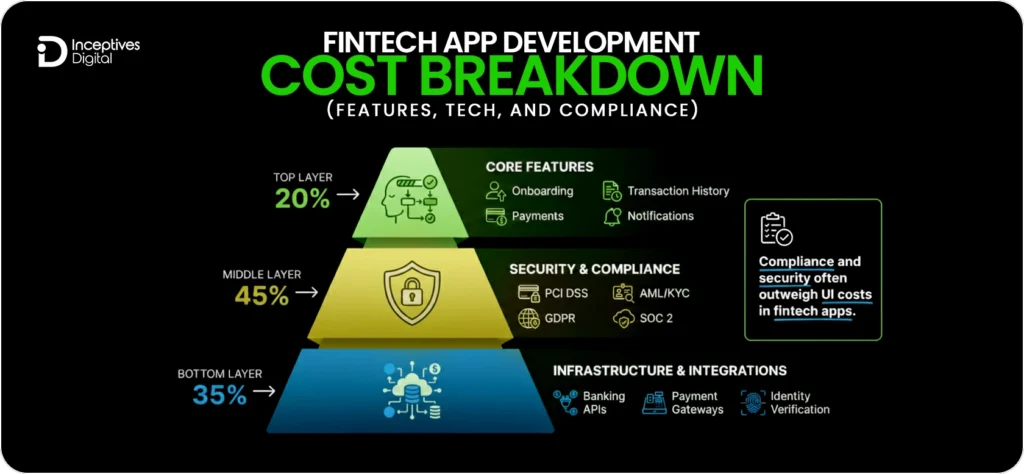
Fintech app development is way more different than programming an interface. Fintech apps are a combination of smart features, solid security, and smooth integrations that people can trust. Every feature you add increases the cost and time.
Breaking down these elements helps you estimate your fintech app development budget accurately and ensures you invest in what truly matters for your app’s success.
1. Core Features Cost
The cost of a project increases with every additional feature. Here’s how fintech features usually affect your budget:
- User Onboarding & KYC Cost: $3,000 – $10,000
The process requires users to complete secure registration while they verify their identity and upload required documents. - Authentication & Encryption Cost: $5,000 – $15,000
Uses multi-factor authentication together with biometric login and encrypted data storage methods. - Payment Processing Cost: $7,000 – $25,000
Enables users to make payments through various methods, which include payment gateways, bank transfers, and wallet systems. - Transaction History & Analytics Cost: $5,000 – $20,000
Provides users and admins with real-time dashboards, reporting tools, and analytics functions. - Notifications & Alerts Cost: $2,000 – $8,000
Sends users push notifications, SMS alerts, and email alerts to inform them about transactions and updates.
You should select the essential features that your MVP needs to have because it will help you minimize your initial expenses.
2. Security and Compliance Cost
The financial technology industry requires security as an essential requirement. Consider this as a must-have part of your budget:
- Regulatory Compliance Cost: $5,000 – $20,000
Ensuring PCI DSS, GDPR, SOC 2, AML/KYC compliance. - Security Architecture & Testing Cost: $5,000 – $30,000
Penetration testing, vulnerability assessments, and secure infrastructure setup.
Cost-cutting in this area will result in savings initially but create significant financial penalties and damage to the organization’s public image.
3. Third-Party Integrations Cost
Most fintech apps rely on external services to function efficiently:
- Banking APIs Cost: $3,000 – $15,000 per integration
- Payment Gateways Cost: $2,000 – $10,000
- Credit Bureaus & Identity Verification Services Cost: $5,000 – $15,000
Your total fintech app development cost will increase with each additional integration, especially when your project demands multiple financial services to operate on a single platform.
Your fintech app development cost should be calculated by summing its required features together with necessary security measures and all essential integration components. Any attempt to cut costs in these segments will lead to negative consequences.
Quick Overview
| Feature | Description | Estimated Cost |
| User Onboarding & KYC | Secure registration, identity verification, and document uploads | $3,000 – $10,000 |
| Authentication & Encryption | Multi-factor authentication, biometric login, and encrypted storage | $5,000 – $15,000 |
| Payment Processing | Integration with payment gateways, bank transfers, and wallet systems | $7,000 – $25,000 |
| Transaction History & Analytics | Real-time dashboards, reporting, and analytics for users and admins | $5,000 – $20,000 |
| Notifications & Alerts | Push notifications, SMS, and email alerts for transactions and updates | $2,000 – $8,000 |
Fintech App Development Cost Estimation by App Category
Fintech apps vary in purpose, and so does their development cost. To make a precise fintech app development cost estimate for your project, it is important to understand the category your app idea falls under. Here is the list of common fintech app types:
1. Cost to Build a Personal Finance App
The main purpose of personal finance applications is to help users manage their finances and monitor their financial habits. These applications typically provide expense tracking features together with budgeting capabilities and user-friendly analytical dashboards. The majority of financial applications use bank synchronization together with data aggregation methods to automatically retrieve users’ transaction information.
Personal finance app development cost usually ranges from $30,000 to $70,000 and is influenced by entities like advanced analytics and third-party integrations.
2. Mobile Banking App Development Cost
Mobile banking applications have grown into complex systems. Users can now handle their accounts, send money, and pay their bills while accessing their current transaction details. The system requires multiple security measures, which include strong security architecture, secure authentication, and deep integration with core banking systems.
The mobile banking app development costs start at $80,000 and reach up to $200,000, but enterprise platforms that require advanced security and compliance features cost more.
3. Fintech Loan App Development Cost
Loan applications depend on automated systems that analyze risks associated with lending. The systems enable automatic credit scoring, which generates loan applications and calculates repayment terms while performing risk evaluations. Many systems additionally support connections with credit bureaus and identity verification services.
The development cost for a fintech loan application starts at $60000 and goes up to $150000 because it depends on the complexity of the credit assessment and loan administration capabilities.
4. Cost to Develop an Insurance Fintech App
Insurance fintech applications handle policy management methods and digital onboarding processes, together with claims processing workflows and user verification procedures. These apps often need to handle documents, perform compliance verification, and establish connections with both insurance companies and their internal systems.
Insurance fintech app development costs begin at $70,000 and reach up to $180,000, depending on two factors, which include the number of policies supported and the complexity of claims processing.
5. Cost to Build a Fintech Super App
A fintech super app combines multiple financial services into a single platform. This platform provides various services, including banking and payments, lending and insurance, and investments. The development of these applications needs both a multi-service system design and the ability to scale, as well as an extended period of infrastructure development.
Fintech super app development costs start from $150,000 and reach upwards of $300,000 because of the project’s extensive requirements and complex nature, which includes performance optimization, security measures, and future growth considerations.
Quick Comparison of Fintech App Development Cost By App Category
| Fintech App Type | Key Features Included | Estimated Cost Range |
| Personal Finance App | Budgeting, expense tracking, bank syncing, analytics dashboards | $30,000 – $70,000 |
| Mobile Banking App | Account management, fund transfers, bill payments, strong security architecture | $80,000 – $200,000 |
| Fintech Loan App | Credit scoring logic, loan lifecycle management, risk assessment systems | $60,000 – $150,000 |
| Insurance Fintech App | Policy management, claims processing, and user verification workflows | $70,000 – $180,000 |
| Fintech Super App | Multi-service architecture, high scalability, long-term infrastructure | $150,000 – $300,000+ |
Fintech App Development Cost Based on Stages
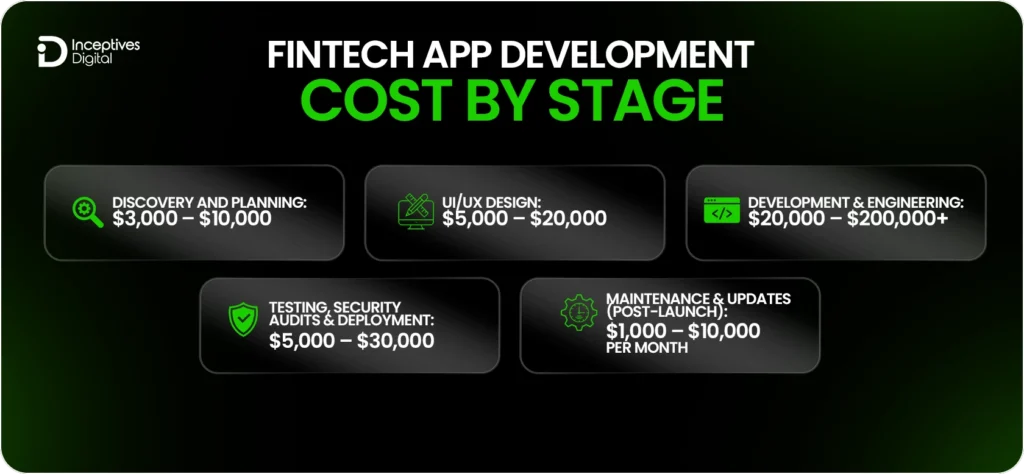
Breaking down the development process into stages makes it clear to understand the fintech app development cost. Each of the stages adds a specific portion to the overall development cost, and skipping or making errors in any of these can result in costlier damages. The following are the main stages involved in the fintech app development process:
1. Discovery and Planning
Estimated cost: $3,000 – $10,000
This is the first and most important stage that sets the tone of the whole development process. The focus is on market research, technical feasibility, and compliance planning. It defines who your target audience is, the core features, and resource requirements. A well-defined plan is crucial to keep your fintech app development costs in control.
2. UI/UX Design
Estimated cost: $5,000 – $20,000
The UI/UX design phase is transforming the business objectives into a functional and appealing experience that attracts and retains users. It involves designing the user experience (structure, wireframe, flow) and the user interface (visual design, interactivity) to make sure an engaging and easy-to-use interface.
3. Development and Engineering
Estimated cost: $20,000 – $200,000+
This is the core building phase that has two parts. The frontend and backend development. Frontend is responsible for the user interface, and backend deals with the data processing, business logics, and API development that connects banks, payment gateways, and third-party services. The main elements that increase the cost at this stage are the complexity level and integration.
4. Testing, Security Audits, and Deployment
Estimated cost: $5,000 – $30,000
It is important to test the application before launch to avoid any rework and bugs. The app goes under rigorous QA testing, penetration testing, and app store regulatory checks. These have so much importance to make sure the app is secure, bug-free, and ready to launch. Improper testing can result in costly maintenance later on.
CTA SECTION START
cta title: Curious How Your Budget is Spent at Every Stage?
cta des: Discover the cost breakdown for discovery, design, development, and testing before you start.
cta button: Get Stage-Wise Estimate
CTA SECTION END
Banking App Development Cost vs Fintech App Development Cost
It is a common assumption that the cost of fintech app development is the same as developing a banking app. The reality is different from that, as both are influenced by distinct constraints. Having a clear distinction between them can help you in cost estimation for your fintech application, realistically and accurately.
Cost of Developing a Banking App
The cost of developing a banking app is usually higher due to strict regulatory requirements and reliance on legacy systems. Conventional banks must combine with existing core banking systems, comply with extensive regulatory requirements, and undergo multiple internal audits to begin their operations. The estimated cost of banking app development lies between $150,000 to $400,000+.
Banking App Development Cost vs Fintech App Development Cost
| Aspect | Banking App Development | Fintech App Development |
| Typical Development Cost | $150,000 to $400,000+ | $30,000 to $300,000+ |
| Primary Cost Drivers | Legacy system integration, institutional compliance | Features, security layers, third-party APIs |
| Compliance Load | Extremely high (bank-grade regulations) | High but flexible based on app type |
| Infrastructure | On-premise or hybrid legacy systems | Cloud-native and scalable |
| Speed to Market | Slow due to approvals and audits | Faster for MVPs and startups |
| Innovation Flexibility | Limited | High |
| Scalability Cost | High and rigid | Gradual and feature-driven |
Why Fintech Apps Can Cost More or Less Than Banking Apps
Fintech companies usually move faster and build on modern cloud infrastructure, which can reduce early-stage costs. The fintech app development rises when companies implement advanced features together with real-time financial data and regulatory compliance requirements.
Summing up, fintech apps are cheaper to launch but can scale to banking-level budgets as complexity grows.
Hidden Costs That Increase the Cost of Developing a Fintech App
If you think that the job is done at the launch of your fintech app, that is not the case. The demand for regulatory and technical maintenance continues to add to the fintech app development cost. These are the reasons that increase the cost over time:
1. Compliance Updates and Regulatory Changes
Fintech regulations and compliance requirements evolve continuously. To keep up with these fintech apps, there needs to be continuous updates in code, workflow adjustments, and testing which adds additional development efforts, thus adding to the overall fintech application development cost.
2. Infrastructure Scaling and Cloud Costs
As the volume of transactions increases, the app must scale to bear this load. As the usage of the cloud, databases, and API costs increase as well, specifically for sensitive financial data.
3. Maintenance, Monitoring, and Feature Upgrades
To keep your fintech app secure, smooth, and bug-free, fintech apps require OS updates, constant monitoring, and feature enhancements. This development work becomes a continuous cost driver.
4. Security Incident Prevention and Response
Fintech applications require regular penetration testing, vulnerability testing, and security updates to prevent threats. In case of any security incident immediate responses quickly become one of the most costly phases.
Estimated Hidden Costs in Fintech App Development
| Cost Area | What Drives the Cost | Estimated Ongoing Cost |
| Compliance Updates | Regulatory changes, audits, and documentation updates | $5,000 to $30,000 per year |
| Infrastructure & Cloud Scaling | Increased users, transactions, and real-time processing | $1,000 to $10,000+ per month |
| Maintenance & Monitoring | Bug fixes, OS updates, API changes, feature upgrades | $2,000 to $15,000 per month |
| Security Prevention & Response | Penetration testing, monitoring, and incident remediation | $5,000 to $50,000 per year |
The real cost of developing a fintech application is driven by what happens after launch, not just the initial build.
Fintech App Development Cost Estimate by Region
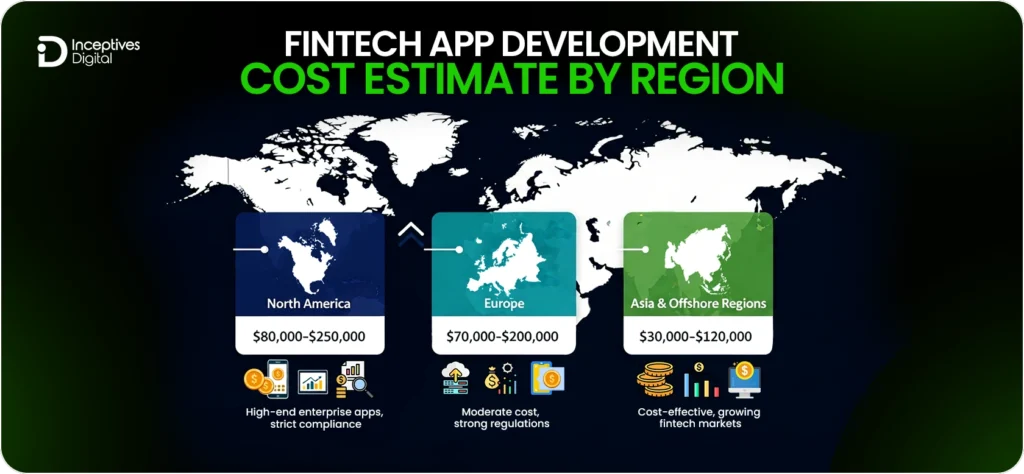
For estimating your fintech app development cost, considering the location of the developers plays an important role. The reason is the widely varying development rates across regions. Understanding these can be proven beneficial in planning an effective fintech app development cost before hiring a team.
Fintech App Development Cost in North America
North American developers are considered to have deep fintech expertise and solid compliance knowledge, especially for products that require strict regulations. If you choose to hire North American developers it can prove to be more expensive but ensure faster delivery with minimum regulatory issues.
Average hourly rates:
$100 to $180 per hour
Estimated fintech project cost:
$120,000 to $300,000+
Best for: Enterprise-grade fintech apps, complex compliance needs, long-term scaling
Fintech App Development Cost in Europe
Hiring European developers offers a balance between cost and quality, with strong experience in PSD2, GDPR, and open banking operations. Although there is a significant difference between Western and Eastern Europe, both are less costly than North America.
Average hourly rates:
$60 to $120 per hour
Estimated project cost:
$80,000 to $200,000
Best for: Payment apps, open banking solutions, regulated fintech platforms
Fintech App Development Cost in Asia and Offshore Regions
Asia and offshore areas provide cost-effective development solutions through their expanding fintech development expertise. The development process requires thorough vetting because security compliance standards demand it.
Average hourly rates:
$25 to $60 per hour
Estimated project cost:
$30,000 to $120,000
Best for: MVPs, startups, cost-sensitive fintech products
Lower hourly rates reduce upfront costs, but fintech experience and compliance readiness matter just as much when finalizing your fintech app development cost estimate.
Lower hourly rates lower initial expenses, but your team’s fintech experience and their ability to meet compliance standards are equally important in determining your final fintech app development cost estimate.
CTA SECTION START
cta title: Get The Best Price Without Compromising on Quality?
cta des: We help you balance cost, security, and fintech experience from day one.
cta button: Get the Best Price
CTA SECTION END
How to Build a Fintech App Without Overspending
Wrong approach and poor planning are the reasons businesses struggle with keeping the development cost under a reasonable level. With smart technology choices and careful planning, you can definitely control the fintech app development cost. Here is how to do it:
How to Build a Fintech App Using an MVP Approach?
Starting with small and manageable steps sets a tone for a successful development journey. Developing a Minimum Viable Product (MVP) focuses on core features, user onboarding, payments, and basic analytics, which proves vital in testing your idea, gathering feedback, and saving unnecessary spending on less important features early.
Benefit: Lower cost to build a fintech app, faster market entry, and reduced risk.
Choosing the Right Tech Stack to Control Fintech Cost
Choosing technologies capable of scaling with growing user demand is essential. Don’t over-engineer, stick to necessary features and flexible systems that can scale with time. Cloud supported backend, reusable APIs, and cross-platform frameworks reduce future costs as well as maintain security and reliability.
Benefit: Controls fintech app development cost while keeping the platform future-proof.
In-House vs Outsourcing Fintech App Development
Having your own team means you’re in charge of everything, but you’ll spend a lot on recruiting and keeping them on board. If you outsource experienced fintech developers, you can actually cut down on costs and speed up development. Honestly, a lot of companies find that getting the best of both worlds—keeping the main planning stuff in-house while letting outsiders handle the engineering—is a smart move for both managing costs and staying in charge.
Benefit: Smarter resource allocation reduces the overall cost to build a fintech app.
Smart Ways to Reduce Fintech App Development Cost Without Cutting Quality
- Start with an MVP by selecting essential features.
- Reuse APIs and third-party integrations that exist in their current system.
- Establish automated testing and monitoring systems that will eliminate the need for manual quality assurance.
- Plan for compliance from the start to avoid expensive rework.
The combination of an MVP together with the correct technology stack selection and proper staff hiring will enable you to launch your fintech application while keeping development expenses under control.
Final Cost Summary: How Much Does It Cost to Build a Fintech App?
Development cost is one of the most obvious concerns for someone thinking about developing a fintech application. The same goes for fintech applications as well. The fintech app development cost is influenced by multiple constraints. A small personal finance tool starts around $30,000, and enterprise fintech solutions or super apps can cost more than $300,000. These themselves seem very expensive, but that’s not the end. Compliance updates, scaling infrastructure, and maintenance are additional costs that add continuously after the launch. Careful planning and smart decision-making really make a difference in keeping the development cost for your fintech solution.
If you are willing to bring your idea in an efficient way, a mobile app development company with a proven track record in fintech app development can streamline the whole process from planning to launch. Get in touch with Inceptives Digital to have a well-defined fintech app development cost estimate to make your fintech app efficient and successful.
CTA SECTION START
cta title: Ready to see what your fintech app should really cost?
cta des: No rough guesses. No inflated numbers. Just a practical cost breakdown based on how your app will actually be built.
cta button: Get My Cost Estimate
CTA SECTION END
FAQs About Fintech App Development Cost
For startups, costs depend on the app type and complexity. A simple personal finance or MVP app typically ranges from $30,000 to $70,000, while more advanced features or integrations can push the cost higher. Starting with an MVP is the best way to manage expenses and test the market.
Yes. Using a Minimum Viable Product (MVP), leveraging cloud infrastructure, and choosing reusable APIs or cross-platform frameworks can lower costs without compromising security. Cutting corners on compliance or encryption, however, is never recommended.
Development timelines vary by complexity. A simple MVP can take 3–4 months, a mid-level app 6–9 months, and enterprise or super apps 9–12 months or more, including design, development, testing, and deployment.
The biggest cost drivers include:
1. App type and complexity
2. Features and third-party integrations
3. Security and compliance requirements
4. Development region and hourly rates
5. Infrastructure and scalability needs
SIDEBAR LIST START
- How Much Does It Cost to Build a Fintech App?
- Quick Answer: Cost to Build a Fintech App Based on App Type and Complexity
- What Is Fintech Application Development and Why Is It So Expensive?
- Fintech App Development Cost Breakdown (Features, Tech, and Compliance)
- Fintech App Development Cost Estimation by App Category
- Quick Comparison of Fintech App Development Cost By App Category
- Fintech App Development Cost Based on Stages
- Banking App Development Cost vs Fintech App Development Cost
- Hidden Costs That Increase the Cost of Developing a Fintech App
- Fintech App Development Cost Estimate by Region
- How to Build a Fintech App Without Overspending
- Final Cost Summary: How Much Does It Cost to Build a Fintech App?
- FAQs About Fintech App Development Cost
SIDEBAR LIST END