The existence of mobile applications is part of how businesses operate today, helping ensure they remain relevant in their fields, from small-scale businesses to giant corporations. Mobile applications are in development to improve the consumer experience and provide avenues for making money.
However, as demand for mobile applications rises, the cost of developing an effective one is also increasing. According to a Statista report, mobile app revenue is set to cross $100 billion in the coming years.
The question on every business owner’s and product leader’s mind is, “Why are the costs of mobile app development so high?” It is important to understand the cost of mobile application development because, in addition to understanding the cost, one must also develop an effective strategy to ensure maximum returns on investment. An improper strategy not only results in the waste of investment and time, but also in an application that is ineffective in meeting the desired business needs.
Several aspects must be considered in this case, including the feature, the technology, the user interface, the user experience, and the developers, regardless of the application’s complexity.
| App Complexity | Estimated Cost Range | Examples | Description |
| Basic App | $5,000 – $40,000 | Calculator, Notes, Weather App | Simple UI, core functionality, minimal logic, no backend or integrations. |
| Moderate App | $40,000 – $120,000 | Food Delivery, Fitness Tracker | User authentication, third-party APIs, payment gateways, and basic backend. |
| Advanced App | $120,000 – $300,000+ | Uber, Airbnb, Spotify | Real-time features, advanced UI/UX, scalable backend, high performance. |
| Enterprise-Grade App | $300,000+ | Banking Platforms, ERP Systems, Large Marketplaces | Complex architecture, enterprise security, integrations, compliance, massive scalability. |
In this context, the services of a mobile app development company can be vital. A business can get guidance on the right technology and features from a mobile app development firm, thereby managing its expenses more effectively without compromising the application’s quality. A business can gain better insight into the distribution of costs and the factors that drive it, thereby maintaining the right balance between innovation and cost efficiency.
Factors that can Reduce Mobile App Development Cost?
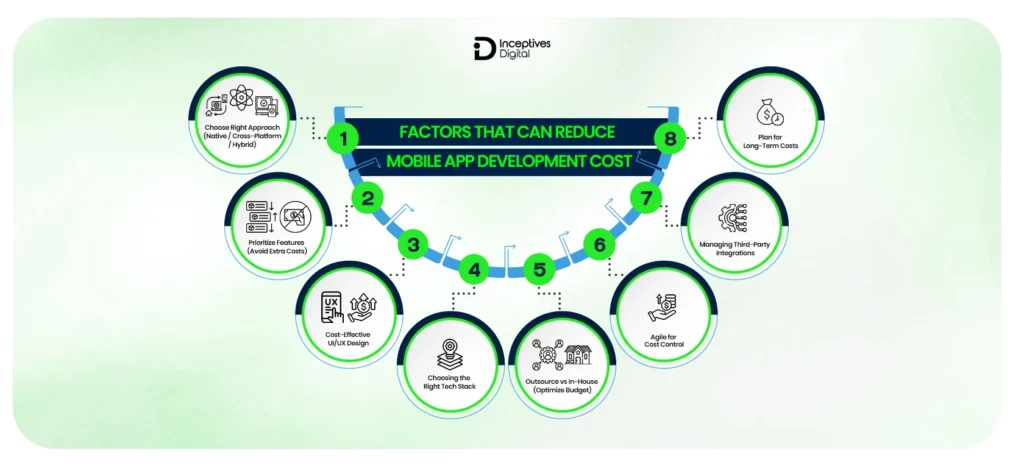
The first step towards understanding mobile app development cost is to identify the components that affect it. It is true that developing an application is a costly endeavor and requires a significant investment. Knowing exactly where your money is being spent is the best way to take the right steps to control costs without compromising quality.
This does not mean compromising quality; it means making wise decisions. From start to finish, every phase is an opportunity to control costs effectively. In the following sections, we will learn about the different aspects of mobile application development and how to control costs effectively.
| Component | Total Cost according to % |
| Planning and Research | 10–15% |
| UI/UX Design | 15–25% |
| Development (Frontend + Backend) | 40–55% |
| Testing and QA | 15–20% |
| Deployment and Launch | 5–10% |
| Maintenance and Updates | 10–20% |
Understanding this breakdown can help businesses identify opportunities to optimize these costs, such as ease of design and key features to consider when designing the MVP.
How Building an MVP Saves Time and Money?
One of the best ways to control the cost of developing a mobile app is to develop a Minimum Viable Product (MVP). The MVP development is essentially the app’s basic form, including the features that address the major problems users will face.
Creating the MVP helps you save time and money in the following ways:
- It will save you time in developing your product, since you are developing only what is necessary to bring it to market.
- It will help you obtain user feedback so you do not end up redesigning or changing your product’s features.
- It will help you bring your product to market quickly so you can begin earning money from it, all at a low cost.
Aside from that, the MVP development cost will help you effectively plan and utilize resources for your mobile app development project. Also, you can avoid wasting money on features that do not add value to your business by improving your app based on actual data.
Choosing the Right Development Approach
The key in this case is to find an effective development strategy that defines the costs of development for the application and its success. Regarding mobile application development, two models may be identified: “Native” and “Cross-Platform.”
Native Development
- Developed specifically for one platform (iOS or Android).
- Uses native languages (Swift or Kotlin).
- Better performance and user experience.
- Higher development cost and time due to a separate codebase.
Cross-Platform Development
- Shared codebase for both iOS and Android apps.
- Uses frameworks (React Native, Flutter, etc.).
- Reduces development cost and time by 30-40%.
- Suitable for startups and MVPs.
Which of the two is to be used depends on whether performance or cost factors are more significant. An in depth evaluation of the need would yield the best results in terms of performance and cost.
Choosing between approaches? Compare Native vs Hybrid vs Cross-Platform App Development.
Feature Prioritization: Avoiding Unnecessary Development Costs
One of the most common reasons for mobile application development costs spiraling out of control is the number of features being added. It is natural to want to include all the application’s features, but it is not always a good idea. Feature prioritization is where this is applied.
Feature prioritization is the process of identifying which features are essential to your app’s basic functionality and which can be incorporated in future updates. This can be done using various frameworks, such as MoSCoW, which has feature levels.
- Must-have – Functionalities that are essential for the launch
- Should-have – Functionalities that are important but not essential
- Could-have – Nice to have functionalities that can be included later
- Won’t-have – Functionalities that do not have immediate value
By focusing primarily on the must have functionalities of the mobile application, the business can ensure a quick launch. This would also enable the business to make the necessary decisions based on the feedback without wasting time and effort on developing the mobile application with unnecessary functionalities.
In addition, with the assistance of a skilled mobile application development company, it can be determined how much time is actually required to develop the mobile application. It can also be determined even if another option on the market offers similar value at a lower cost. By strategically organizing the application, it can be made user-friendly and cost-effective.
Reducing UI/UX Design Costs Without Compromising Experience
The role that design plays in the success of a mobile app is of utmost importance, as it can affect user experience, satisfaction, etc. On the other hand, the UI/UX design of a mobile app is also an important factor in determining the cost of mobile app development. Thus, the challenge is to reduce costs without affecting the UI/UX design.
Using Pre-Built Design Systems and UI Kits
Using pre-built UI kits ensures your application maintains a consistent look and feel across all screens. Besides, using pre-built UI kits will save you a lot of time in designing your application.
Using Platform Design Guidelines
Using design guidelines from platforms such as Apple’s Human Interface Guidelines or Google’s Material Design will help you design your application more easily. Besides, using design guidelines offered by platforms will ensure a good user experience.
Keeping the User Interface Simple
It is always advisable to avoid adding complex user interfaces, animations, etc., to your application design, as this can increase its complexity.
Focus on Usability
If you keep usability in mind for your user interface, you can rest assured you will deliver a good user experience to your clients without adding complexity to your design.
Optimize Design with Expert Support
If you get professional advice on your design or hire a company to design and develop your application, you can rest assured that you will be able to deliver a good design. This will also prevent you from incurring unnecessary redesign expenses.
Selecting a Cost-Efficient Tech Stack and Development Tools
The most important decision in developing a mobile application is the technology stack, as both cost and time are influenced by it. An efficient technology stack is required to make the mobile application scalable, simple, and not overly complicated.
Choosing the Right Frontend and Backend Technology
Select the appropriate programming languages for your applications based on your requirements.
Using Cross-Platform Frameworks for Cost Benefits
Using cross-platform frameworks like React Native and Flutter enables developers to build applications that run on both iOS and Android, helping companies cut costs by 30-40%, especially for startups and MVPs.
Choosing the Appropriate Technology Stack for Native Development
Using technologies such as Swift and Kotlin is recommended for creating feature-rich apps.
Using Backend as a Service (BaaS)
Using platforms such as Firebase and AWS Amplify helps companies leverage features like user authentication and cloud storage, which are cost-effective in the long run.
Adopt Open-Source Solutions
Significant reductions in licensing costs and overall development costs are possible.
Invest in Efficient Development Tools
Productivity, accuracy, and elimination of rework are greatly facilitated.
Select Scalable Technology Stack
It is vital to assess scalability to avoid future redevelopment.
Work with Experienced Experts
Experienced experts can help select the best technology stack that meets your performance, scalability, and cost-effectiveness requirements.
Outsourcing vs In-House Development: Which Option Saves More?
In terms of cost management, one of the most significant decisions that a business has to make is whether to outsource the project or develop it in-house. Even though both options have advantages and disadvantages, the decision depends on the business’s requirements.
In-House Development
Developing the project in-house will give you full control, the opportunity to work closely with your team, and the benefit of that knowledge. At the same time, it should be noted that developing an in-house team requires programmers, designers, and quality assurance experts, which makes mobile app development costly. For a new business, it is not cost-effective to develop an in-house team.
Outsource Development
On the flip side, outsourcing also provides you with access to global talent and mobile app development companies without having to hire them on a full-time basis. For example, if you hire from Asia or Eastern Europe, you could save up to 30-60% on your mobile app development costs. This is what you get with an outsourced solution: flexibility. This is especially important if you are building an MVP.
| Factors | In-House Development | Outsource Development |
| Cost | High (salaries, tools, infrastructure). | Lower (30–60% cost savings). |
| Control | Full control over the team and processes. | Limited control (vendor-dependent). |
| Team Setup Time | Time-consuming (hiring and onboarding). | Faster (ready-to-deploy teams). |
| Flexibility | Less flexible (fixed team size). | Highly flexible (easily scales up/down). |
| Expertise Access | Limited to in-house skills. | Access to a global talent pool. |
| Communication | Direct and smoother. | May face communication/time zone challenges. |
| Best for | Large companies with long-term projects. | Startups, MVPs, and budget-conscious projects. |
| Maintenance | Managed internally. | Often supported by an outsourcing partner. |
The challenges you would face with outsourcing also need to be factored in. In conclusion, it is highly recommended that you consider hiring a mobile app development company to achieve the highest savings while maintaining quality. For this, you should make the right decision by considering your requirements and duration.
Using Agile Methodologies to Control Costs and Reduce Rework
One of the best ways to keep mobile application development costs in check while ensuring flexibility and improving the process is to adopt Agile methodologies. Unlike traditional methodologies, where the application development process is linear, Agile is based on iterative development, with the project phases divided into cycles, or sprints.
- The biggest benefit of adopting Agile methodologies is the feedback mechanism, which ensures the application stays in sync with its stakeholders and avoids unwanted features that could add to development costs.
- Adopting Agile methodologies is that they enable efficient resource use. This means that the development teams will ensure that the most impactful features are implemented.
It also enables efficient collaboration among developers, designers, and other stakeholders. This will help in efficient communication and avoid confusion. When you work with an experienced mobile app development company, Agile methodologies will definitely help with an efficient development process, reduce risks, and ensure that every stage contributes to cost optimization.
Agile helps accelerate development, reduce waste, and keep the project within budget by optimizing costs and reducing risks.
Managing Third-Party Integrations Without Overspending
These third-party integrations include payment systems, analytics systems, social media login systems, and APIs. Third-party integrations are essential for ensuring your application delivers the best user experience without requiring users to develop them themselves. However, third-party integrations can become a hidden cost in your application.
To effectively manage third-party integrations in your application and avoid hidden costs, there are some things you should do.
First, you should determine whether a given integration is essential to your application. It is essential to avoid integrating tools and services in your application that do not add value. It is essential to avoid integrating plugins into your application, as they add unnecessary complexity to development.
It is essential to compare different tools and services and establish those with a licensing policy. These factors you should consider:
- The quality of the API. This can help in reducing costs and time involved in debugging. Next is the solution’s scalability. It is easier to scale a cloud-based solution rather than one developed from scratch. This can help reduce costs during surges in user traffic.
- Limiting customizations in the solution. This can help reduce costs, as excessive custom development should not be done unless required by the business, whereas APIs can meet requirements in most cases.
- Monitoring usage of the solution and customizing integrations to avoid unused services.
Long-Term Cost Optimization (Maintenance, Scaling, and Hidden Expenses)
It is also important to ensure that your app is sustainable and profitable in the long term. By strategically planning their mobile app’s maintenance costs, businesses can avoid costly mistakes and ensure it runs efficiently.
Regular Maintenance Planning
You should set aside 10-20% of your app’s budget for maintenance. This will help you avoid costly problems that could cost your business in the future.
Efficient Scaling Strategies
Plan the architecture of your app to be scalable. This will help you avoid costly mistakes when adding more users to your app. Scalability will also be cost-effective when using cloud-based infrastructure.
Monitoring Hidden Expenses
Always keep an eye on expenses, including API, integration, and server costs. Make sure you cancel unused services, as they might be costing you money.
Automated Testing and Monitoring
Using automated testing tools will help you avoid costly fixes in the future. This will also ensure that you provide a wonderful experience for your users.
Future-Proof Tech Stack
Use widely supported and flexible solutions that require minimal rework. Scalable solutions will save redevelopment costs in the long run.
Outsourcing Maintenance When Needed
Hire reliable companies for maintenance and server handling. This will save the money that would otherwise be spent on maintenance staff.
User-Driven Feature Updates
Implement new features only if users request them. This will save money by avoiding the development of unnecessary features.
Documentation and Knowledge Management
Keep proper documentation for code and APIs. This will save time and money on training new programmers and reduce mistakes.
Read more about the other factors that affect mobile app development costs.
Real-World Cost Saving Case Example
The initial cost of developing the food delivery app was over $100,000. The startup decided to develop an MVP with essential features like user registration, restaurant listing, and ordering to cut down costs. This helped them launch their app with costs under control.
The startup used a cross-platform framework to develop its iOS and Android applications. They also used third-party APIs for payments, maps, and notifications.
The startup used an Agile methodology to develop its app. They outsourced some of the project to improve it based on user feedback. They could launch their app for $60,000 to $70,000, which is 30-40% cheaper. They also tested their idea and generated some income to invest in other features.
To Sum This Up
Businesses need to understand the costs involved in developing mobile applications. By doing so, they can optimize costs in mobile application development and deliver a better user experience. Experienced mobile app development companies can help businesses develop mobile applications efficiently and cost-effectively, no matter if it’s small or large.
By developing MVPs and adopting Agile methodologies, businesses can launch mobile applications quickly, reducing future costs. Effective management of integrations, maintenance, and future tech stacks can help businesses optimize the costs involved in mobile app development. By applying these strategies, businesses can make informed decisions and choose the right mobile app development company.
CTA SECTION START
cta title: Want to Build a Mobile App Without Overspending?
cta des: Build your app 30–50% cheaper with the right strategy. Talk to our experts and get a free cost estimation today.
cta button: Let’s Talk
CTA SECTION END
FAQs
The most cost-effective approach is to develop an MVP, use cross-platform development tools, focus on core features, and adopt Agile development methodologies.
An MVP involves only basic features that allow businesses to collect user feedback, avoid unnecessary features, and minimize development costs.
Cross-platform app development with React Native and Flutter enables businesses to deploy mobile apps on both iOS and Android with a single codebase. This approach saves 30-40% on development costs, whereas native development is more expensive but delivers high-performance mobile apps.
Yes, outsourcing mobile application development services to experienced development teams, especially in cost-effective regions, can save 30-60% on development costs.
Agile development methodologies divide mobile application development projects into sprints, enabling businesses to implement iterative testing, rapid development, and continuous feedback. This approach prevents rework, saves unnecessary costs, and keeps the project within budget.
SIDEBAR LIST START
- How to Reduce Mobile App Development Costs?
- Factors that Can Reduce Mobile App Development Cost
- How Building an MVP Saves Time and Money
- Choosing the Right Development Approach
- Feature Prioritization: Avoiding Unnecessary Development Costs
- Reducing UI/UX Design Costs Without Compromising Experience
- Selecting a Cost-Efficient Tech Stack and Development Tools
- Outsourcing vs In-House Development: Which Option Saves More?
- Using Agile Methodologies to Control Costs and Reduce Rework
- Managing Third-Party Integrations Without Overspending
- Long-Term Cost Optimization (Maintenance, Scaling, and Hidden Expenses)
- Real-World Cost Saving Case Example
- To Sum This Up
- FAQs
SIDEBAR LIST END