MVP in mobile app development is an excellent approach for transforming an idea into a functional product without developing everything at once. It is based on launching a minimal version of the app with only the most basic features required to address a particular problem. This will enable businesses to test their ideas in a real-world market setting before fully developing them.
Several businesses opt for MVP mobile app development because it offers more time and helps keep a check on the development process. Rather than investing heavily in a fully functional product, they develop a simple version of the app, gather user feedback, and then gradually improve it. This helps them control and mitigate the risk of failure and ensures that all future upgrades are developed based on actual user needs.
According to recent industry insights from Statista, consumer spending on leading app marketplaces such as Google Play and Apple App Store is expected to reach around $233 billion by 2026.
The best mobile app development company helps maintain the most essential features, create an effortless user experience, and lay a firm foundation for future growth. With proper planning and technical support, businesses can test their ideas, identify unnecessary expenses, and then move ahead with confidence towards a successful app.
What Is MVP in Mobile App Development?
MVP in mobile app development is creating the first version of the app with only the most essential features. An MVP of a mobile application is not a full-fledged product but a basic, functional version that provides the primary value to users. It assists businesses in transitioning from an idea to a launch without investing too much time and money in the initial phase.
The primary intention of MVP is to launch the app with the minimum necessary features. Rather than incorporating refined features or additional tools, attention remains on the fundamental feature that resolves the user’s primary issue. This ensures that the development process remains uncomplicated.
Another significant intention of MVP development is to test market demand and gather user feedback. As soon as the app is launched for real users, businesses can observe how users interact with it, what they like, and what they want to change.
Why MVP Mobile App Development Is Important for Startups and Businesses?
MVP mobile app development is important for startups and existing businesses because it allows them to launch their mobile app quickly, with only the most essential features.
It also helps cut down costs, and risks associated with financial investments. Rather than spending a heavy budget on developing a fully developed product, businesses can start testing their product with a smaller budget. If you need a modification, they can develop their app feature without incurring significant losses.
Another advantage of launching an MVP is that it helps with real-world validation of the idea. Businesses can monitor their app’s performance in the real world and make well-informed decisions.
Features of a Successful Mobile App Development MVP
A successful mobile app development MVP focuses on delivering real value with limited but meaningful features. It should be practical, easy to use, and built in a way that allows future improvements. The goal is not to add everything at once, but to build a sound foundation.
Problem Solving Core Functionality
The MVP should focus on solving one main problem for users. It must include only the most important features that make the app useful. Removing unnecessary extras keeps the product clear and effective.
Simple and User-Friendly UI/UX Design
The UI/UX design should be clean and easy to understand. Users should be able to guide the app without confusion. A simple layout improves the user experience and increases the likelihood that users will return to the app.
Scalability for Future Upgrades
Even though the MVP is basic, it should be built on a structure that supports future growth. The code and system should allow new features to be added easily. This saves time and effort when expanding the app later.
Basic Analytics Integration
Analytics tools should be included to track user behaviour. This helps businesses understand how users interact with the app. The collected data supports better decisions for updates and improvements.
For example, a startup company developing a fitness app may assume that its users are interested in 20 features. However, after the launch of the MVP, they may realize that their users are only interested in tracking their workouts and seeing their progress.
Not all features have to be developed in the first version. In fact, most features should not.
Real-World Examples of Successful MVPs
Many well-known digital products did not begin as fully developed platforms. They started small, tested their ideas, and improved step by step. These early versions focused only on solving one obvious problem. Looking at authentic examples helps businesses understand how powerful a simple MVP can be.
Airbnb
Airbnb began in 2008 when its founders rented out air mattresses in their apartment to visitors who could not find hotel rooms during a conference. Their first version was a simple website that listed their space with basic photos and pricing. There were no advanced filters, no mobile app, and no global listings. It was just a small test to see if people would pay to stay in someone else’s home.
This early step helped them confirm demand. Once they saw that people were willing to book and that hosts were interested in listing spaces, they gradually added features such as user profiles, reviews, secure payments, and improved search options.
Uber
Uber started as UberCab in 2009. The first version worked only in San Francisco and allowed users to book black luxury cars through a simple app. It did not support multiple ride types, price comparisons, or driver incentives. The goal was straightforward: press a button and get a ride.
By limiting the launch to one city and one service type, the founders could test if people liked the idea of booking rides through a smartphone. After seeing strong demand, they expanded to more cities and introduced additional services, such as shared rides and different vehicle categories.
Dropbox
Dropbox took a different approach; instead of building the full product immediately, the founder created a short demo video that showed how the file-sharing system would work. The video explained the problem of carrying files on USB drives and demonstrated a simple solution that syncs files automatically across devices.
The response to the video was strong, and thousands of people signed up to join the waiting list. This confirmed that there was actual interest before heavy development began. After validating demand, the team built the product and iterated on it to address user needs.
Important points from these MVPs
- Start small and focus on one clear problem.
- Test the idea in a limited market or with a limited set of features.
- Use real user responses to guide future updates.
- Expand only after confirming demand.
These examples show that success often begins with a simple version of an idea. A carefully planned MVP allows businesses to test, learn, and grow without taking unnecessary risks.
MVP Development Process
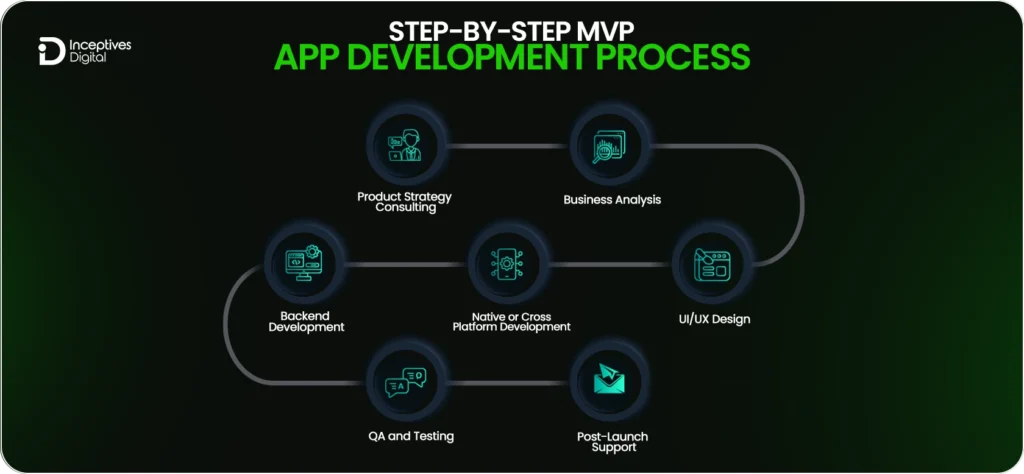
Building an MVP is not about rushing an app to market. It is a structured process that focuses on clarity, planning, and practical execution. Each step makes sure that the final product solves a real problem and is ready for real users.
Below is a clear breakdown of how the MVP development process usually works.
1. Market Research and Idea Validation
Businesses study competitors to see what similar apps are offering, where they perform well, and where they fall short. The first step is to understand the market, as this helps identify gaps and opportunities in competitor analysis.
Businesses also define who their users are, what problems they face, and how they currently solve them. Target audience research is equally important for conducting surveys, interviews, and online research to provide useful insights.
Finally, the idea must demonstrate a strong problem-solving approach. The app should clearly solve a specific issue. If the problem is unclear or not strong enough, the product may struggle in the market.
2. Feature Prioritization
Once the idea is validated, the next step is deciding which features to include. The focus should be on features that directly solve the core problem. Nice to have features that can be saved for later updates.
Businesses outline how users will move through the app, from signing up to completing the major action. User mapping is also important at this stage as it ensures that the MVP remains simple and functional.
3. UI/UX Design
Design begins with wireframing and prototyping. Wireframes show the basic structure of each screen, while prototypes give a clearer view of how the app will function. This stage helps visualize the app before development starts.
The goal is to create an easy user experience. Navigation should be simple, layouts should be clean, and users should complete actions without confusion.
4. Development Phase
During development, teams often follow an agile approach. This means building the app in small stages, reviewing progress regularly, and making improvements along the way.
Both backend and frontend systems are set up during this phase. The frontend handles what users see and interact with, while the backend manages data, servers, and overall functionality.
5. Testing and Launch
Before launch, the app goes through quality assurance testing. Developers check for bugs, performance issues, and security gaps. Fixing problems early prevents negative user experiences.
After testing, a beta launch may be done with a limited group of users. Their feedback helps identify final improvements. Once the app is stable and refined, it is officially launched to a wider audience.
For better testing and launch, it is important to build fast, but building the right thing matters more.
Benefits of Hiring an MVP Mobile App Development Company
Choosing the right team for MVP development can make a major difference in your app’s success. An experienced MVP mobile app development company not only builds the product but also guides strategy, planning, and future growth. Their structured approach helps avoid common mistakes and makes sure smooth execution from idea to launch.
1. Technical Expertise and Industry Knowledge
A professional team understands different technologies, frameworks, and market trends. They know how to select the right tools and build a stable MVP that performs well. Their industry experience helps in solving technical challenges efficiently.
2. Faster and Structured Development Process
An experienced company follows a clear development roadmap. With defined stages and proper planning, the project moves smoothly without confusion. This structured process reduces delays and helps launch the MVP on time.
3. Scalable Architecture Planning
A reliable development company builds the MVP on a firm foundation. The app is designed to allow easy upgrades and future feature expansion. This saves time and prevents major system changes later.
4. Cost Control and Risk Reduction
Professional teams help prioritize essential features and avoid unnecessary additions. This keeps the budget under control and lowers financial risk. Businesses can test their app ideas safely before investing in full-scale development.
5. Post launch Support and Optimization
After launch, continuous monitoring and updates are important. A trusted company provides maintenance, fixes issues, and improves performance based on user feedback. This ongoing support helps the app grow steadily in the market.
Cost of MVP Mobile App Development
The cost of development will depend on factors such as the features to be included, the platform to be used, the complexity of the development, and the location of the development team. An MVP will include only the basic features, making it cheaper than developing a full-fledged app.
- The average mobile app MVP development cost is between $15,000 and $60,000.
- A simple MVP app with basic features can cost anywhere between $15,000 to $25,000.
- A medium-complexity MVP app can cost between $25,000 and $40,000.
- A complex MVP app with integrations and custom features can cost between $40,000 and $60,000, or more.
Mistakes to Avoid in Mobile App Development MVP
Building an MVP requires focus and simple decision-making. Many businesses fail not because the idea is weak, but because of poor planning and execution. Avoiding common mistakes in mobile app development for MVP can save time, money, and effort while increasing the chances of long-term success.
1. Adding Too Many Features
Focusing on too many features can confuse users and complicate the app. An MVP should prioritize essential features that directly solve a problem. Adding unnecessary functions increases development time and costs, while distracting from the app’s core value. Stick to simplicity for a better user experience and clearer testing.
2. Ignoring User Feedback
User feedback is essential for the success of an MVP. Ignoring it can lead to poor product development and missed opportunities. Regularly reviewing feedback helps identify what works, what doesn’t, and what users truly want, allowing for more effective updates and improvements.
3. Skipping Proper Market Research
Skipping market research risks building an app that doesn’t meet user needs. Understanding your target audience and competitors ensures your MVP is relevant and solves a real problem. Without research, you may waste time and resources on features that won’t resonate with your audience.
4. Poor Feature Prioritization
Without proper prioritization, MVP development can become unfocused. It’s crucial to distinguish between must-have features and those that can be added later. Prioritizing essential features ensures the app stays simple and effective, with room for future growth.
5. Choosing the Wrong Development Company
Choosing an inexperienced app development team can lead to delays, technical issues, and increased costs. A skilled company will deliver a high-quality MVP, guide you through the process, and ensure that the app is built on a scalable, user-focused foundation.
How to Choose the Right Mobile App Development Company for MVP?
Selecting the right mobile app development company for your MVP is an important decision. The right team can help turn your idea into a working product, while the wrong choice can lead to delays and wasted budget. Here are key factors to consider before making a decision:
1. Check Their Portfolio
When selecting an app development company, reviewing their portfolio is the top priority. Look at the types of apps they’ve previously built, especially ones similar to your MVP. This will give you a sense of their experience, and even if they have the skills to handle your project. A strong portfolio shows that they can deliver quality work and understand the unique challenges of MVP development.
2. Update Technical Expertise
Ensure the development company is proficient in the technologies your app needs. They should have a solid understanding of both backend and frontend development, APIs, and scalable architecture. Their expertise will directly affect the app’s performance, scalability, and ability to handle future upgrades. Choosing a company with strong technical know-how ensures a stable foundation for your MVP and long-term growth.
3. Understand Their Development Process
Ask the development company to walk you through their process. A reliable team should have a clear, structured approach, with defined stages, timelines, and regular checkpoints. Understanding their workflow will help you stay on track and avoid delays. Transparent communication and a well-planned process also ensure smoother collaboration and minimize the chance of surprises during development.
4. Read Client Reviews and Testimonials
Client reviews and testimonials offer invaluable insight into a company’s reliability, communication, and ability to meet deadlines. Look for feedback on the quality of their work, responsiveness, and overall satisfaction. Positive reviews, repeat business, and long-term client relationships are powerful indicators that the company is trustworthy and can deliver on its promises. Researching their reputation will help you make a more informed decision.
5. Discuss Budget and Transparency
A professional development company should be transparent about costs and timelines. Ask for a clear estimate of the total project cost and any potential additional expenses. Make sure they outline the scope of work so there are no hidden costs. Transparency in pricing helps avoid unexpected financial surprises and ensures that both parties have clear expectations from the start.
6. Post-launch Support
MVP development doesn’t end after the initial launch. Make sure the company offers post-launch support, including maintenance, bug fixes, updates, and performance improvements. The app’s first version is likely to need adjustments, and ongoing support ensures the app strengthens with user feedback and market changes. A company that provides reliable post-launch services helps you maintain a competitive edge.
Choosing the right development team ensures that your MVP is built on a solid foundation and can scale as your business grows.
Final Thoughts
MVP in mobile app development enables businesses to develop an app from an idea without having to develop everything at once. Instead of investing heavily in a fully featured product from day one, companies can start with a simplified version that focuses on solving the core problem. This approach helps reduce app development costs, minimise risks, and make improvements informed by real user feedback. At Inceptives Digital, we develop MVP apps that can scale up with your business.
CTA SECTION START
cta title: Ready to turn your app idea into reality?
cta des: Get in touch with our team today to start building your MVP with a results-focused strategy.
cta button: Contact Us
CTA SECTION END
Minimum Viable Product Development FAQs
MVP development usually takes between 8 and 16 weeks. The exact timeline depends on the number of features, app complexity, and the chosen platform. A simple app with basic functions can be completed faster, while apps with integrations or custom features may take a few extra weeks.
The cost of an MVP ranges from $15,000 to $60,000. Pricing depends on features, design requirements, development region, and even if the app is built for one platform or both. A simpler MVP costs less, while apps with advanced functionality require a higher budget.
No, MVP is not limited to startups. Established businesses also use MVP development to test new ideas, enter new markets, or launch additional services. It helps businesses reduce risk before investing in a full-scale product.
After launch, user feedback and performance data are carefully reviewed. Businesses identify what works well and what needs improvement. Based on real usage, new features are added, and necessary changes are made before expanding the app further.
Yes, a well-performing MVP can attract investors. When an app shows real users, engagement, and market demand, it builds credibility. Investors are more likely to support a product that already demonstrates potential rather than just an idea on paper.
SIDEBAR LIST START
- What is MVP in Mobile App Development?
- Why MVP Mobile App Development is Important for Startups and Businesses
- Features of a Successful Mobile App Development MVP
- Real World Examples of Successful MVPs
- MVP Development Process
- Benefits of Hiring an MVP Mobile App Development Company
- Cost of MVP Mobile App Development
- Mistakes to Avoid in Mobile App Development MVP
- How to Choose the Right Mobile App Development Company for MVP?
- Final Thoughts
- FAQs
SIDEBAR LIST END