In the current mobile application space, businesses can no longer design apps for a single platform. While the Android OS dominates the global mobile OS market share by about 70%, iOS dominates the high-end revenue space. According to Statista, the global mobile app market is expected to grow to $673 billion in revenue.
The idea of cross-platform mobile app development has completely changed from a cost effective approach to a strategic decision for mobile development. With the latest technologies, such as Flutter and React Native, development has improved considerably, allowing developers to build native mobile apps using shared rendering engines and platform bridges. Rather than managing separate codebases for iOS and Android, written in Swift and Kotlin, respectively, businesses can use a single codebase.
From a technical perspective, this helps remove redundancy at the presentation layer and enables smooth native API integrations via platform channels or bridging modules. This helps reduce technical debt and increase maintainability. For businesses operating in a dynamic environment, development speed and scalability are essential, and cross-platform development tools cater to them well. With the ability of advanced features such as real time rendering, animations, as well as backend integrations via Firebase, REST APIs, or GraphQL, cross-platform development is a perfect option that is technically optimized.
For businesses looking to test out their ideas quickly and minimize engineering costs, cross-platform app development can prove to be an efficient solution. With the help of a cross-platform app development company or by developing an internal team, companies can achieve faster market solutions and efficient scalability.
What is Cross Platform App Development?
Defining cross-platform can be tricky, since it’s not a single approach to app development. If you want to know what it is, you can easily guess that it is an app that works well on any platform. The main point that makes cross-platform unique is that it typically uses a single codebase. More to add: the codebase is shared or reused and can be deployed across various mobile platforms.
With such multipurpose platforms as cross-platforms, there is one platform that is native app development, which is only for a single platform. For more differences, see below the major points that distinguish them in basic usage.
Cross-Platform vs Native App Development: Key Differences
The fundamental difference between cross-platform and native app development is that native development allows the app to be built specifically for a single platform, using specific platform programming languages such as Swift for iOS and Kotlin for Android. This allows the app to utilize the device to the maximum potential. Cross-platform development, on the other hand, allows developers to create an app for iOS and Android using a single codebase.
Recognizing major differences is essential for businesses that want to match their technology strategy with their budget, timeline, and performance needs. By making an informed decision, businesses can ensure that the technology development method they choose meets their needs in the short and long term. Below are the differences between native vs cross platform app development:
| Cross-Platform App | Native App |
| One reusable codebase for all platforms. | Separate codebases for both platforms, iOS and Android. |
| Cost effective as it requires a single, smaller team for both platforms. | Needs higher initial development and maintenance costs. |
| Good, but might fall behind native apps in some cases. | Superior performance due to the use of optimised code. |
| Cross platform apps can be customized to resemble native apps. | Native apps have UI guidelines for each platform. |
Best Cross-Platform Mobile App Development Frameworks in 2026
Businesses need a proper workflow and a flexible process to operate their entire system in one go. The cross-platform mobile app development frameworks, such as Flutter and React Native, are in high demand among companies and businesses to enable smooth workflows across platforms. Moreover, any of these platforms can be the ideal choice, depending on the project size, target audience, and performance needs.
Here are the best 5 cross-platform frameworks for mobile app development:
Flutter
Flutter is a leader in the Google UI toolkit and a free, open source toolkit built with the Dart language. It is UI-driven app development that offers excellent performance without lacking speed or ease of use. Flutter app development not only supports apps but also works well for web and desktop applications.
The popularity of Flutter in 2026 can be measured by its performance to develop highly responsive, visually appealing UIs. It allows developers to make changes to the code using its “hot reload” feature, which makes the process more productive. It also receives community support, which improves the development process by adding more features, widgets, and libraries.
More to add: it makes Flutter the best choice for businesses seeking to create scalable app solutions. Additionally, the ability to create web and desktop applications extends Flutter beyond mobile applications.
React Native
React Native is also a free, open source platform, meaning it’s available to anyone. This framework is best known for iOS and Android app development using languages like JavaScript and React, a popular library for web development.
React Native app development helps mobile applications that offer native development benefits while allowing them to use JavaScript, making it a favorite among web developers who want to develop mobile applications. This is because the framework includes an extensive library of components that help developers build mobile applications faster.
In addition, the large number of users helps developers build mobile applications by providing many resources to overcome the complexity of mobile development. With its cross-platform capabilities, it remains the best framework for developing mobile applications for iOS and Android.
.NET MAUI
This popular Microsoft cross-platform app development framework is also free and open source. .NET MAUI is one framework that relies on C#. This framework offers a modern, cross-platform mobile app development platform to improve speed and codebase. In addition, it supports a variety of app architectures, including Model-View-ViewModel (MVVM), Model-View-Controller (MVC), and Model-View-Presenter (MVP).
.NET MAUI platform has become extremely popular among developers because of its ability to integrate smoothly with the Microsoft ecosystem. It allows developers to create cross-platform applications for Android, iOS, macOS, and Windows. Developers can use C# to create applications in a single codebase.
It also enables developers to access native APIs, making the platform extremely powerful for building performance based applications. It also enables developers to create applications using multiple architectures, such as MVVM, MVC, and MVP.
Cordova
Cordova is the popular framework for building hybrid mobile applications. The framework is open source and is supported by Adobe and PhoneGap. It is written in HTML5, CSS3, and JavaScript. Additionally, the Cordova framework provides native plugins and a container for each mobile platform.
Cordova is considered a legacy hybrid solution and is often replaced by Ionic with Capacitor in modern architectures due to improved performance, native API access, and better long-term maintainability.
Cordova provides an easy yet effective solution for building hybrid mobile applications using traditional web technologies like HTML5, CSS3, and JavaScript. Additionally, it allows developers to use native device features via plugins, thereby helping create feature rich applications.
The open source nature of Cordova allows it to be developed by many, thereby creating more plugins for the platform. Cordova is responsible for providing platform-specific containers for Cordova-based applications, which can be easily supported on iOS, Android, and more, thereby helping developers create applications for many.
Ionic
One of the best hybrid frameworks is Ionic, which bridges the gap between the properties in demand and is open source. These properties are easy to maintain, read, and scale. This framework comes with its own library of tools (HTML, CSS, and JS components) that help build the most interactive, visually appealing apps.
Ionic is considered one of the most powerful and easy to use frameworks for building hybrid mobile apps. This framework is highly effective at building high performance apps, all because of its rich library of pre designed elements. The Ionic framework is compatible with Angular, React, and Vue, making it even more effective. This is known as being compatible with building dynamic user interfaces.
The framework is compatible with Progressive Web App development, which are highly effective at reaching customers across platforms. The framework is highly effective and provides extensive resources for building successful apps.
Alibaba and Google Ads are among the companies that use Flutter to build high performance apps that run on iOS, Android, and the web. Hot reload, for instance, can help the developer experiment with the UI rapidly. This can be very useful for creating a visually rich, responsive UI.
Benefits of Cross Platform App Development
As you read above, cross-platform app development services are useful across all operating systems. Cross-platform app development provides many benefits by using a single codebase across numerous operating systems. Here you can go through the 5 major benefits of cross platform app development:
- Cost Effective: The major benefit of cross-platform app development is that it reduces development costs, since you only maintain one codebase. How it builds separate apps for iOS and Android, cross-platform development allows you to write one app that works on both platforms.
- Faster Time to Market: You won’t have to wait for separate versions for each operating system, speeding up the time to reach your audience. With a single codebase for multiple platforms, you can launch your app faster.
- Wider Audience Reach: You don’t have to choose between platforms, allowing you to attract users across different devices. With a larger audience, you can reach a broader user base.
- Easier Maintenance: Instead of updating separate apps, you only need to make changes in one place, ensuring your app stays current without extra work.
- Consistency: Cross-platform development ensures a consistent user experience across different devices. Your app will look and feel the same, even if it’s used on multiple devices.
- Better Resource Management: Development teams can focus on improving features instead of duplicating work across platforms. Since you’re using one codebase, you can allocate your resources more efficiently.
- Access to Native Features: With modern frameworks like Flutter and React Native, cross-platform apps can access device native features, such as the camera and GPS, delivering a high-quality user experience comparable to native apps.
Step-by-Step Process to Build a Cross-Platform Mobile App
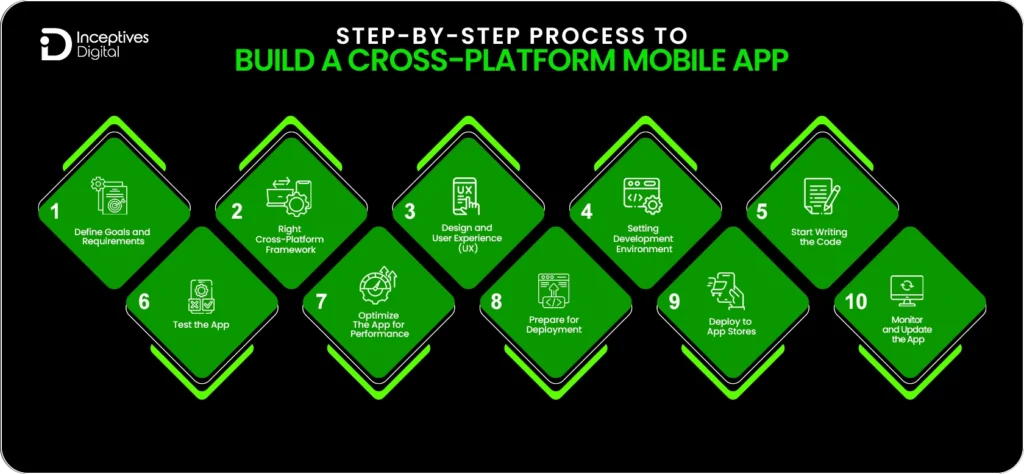
Building a cross-platform mobile app is a long process that involves a step-by-step approach, from an idea to launch across multiple platforms. Here are 10 steps to build a cross-platform application on mobile:
1. Define Goals and Requirements
Start by clearly defining your app’s purpose. What problem does it solve for your target audience? This could be anything from entertainment to productivity. Make a list of essential features, such as push notifications, in app purchases, or social media logins. Define supported platforms, OS versions, and device coverage, as this will influence your development approach.
2. Right Cross-Platform Framework
The choice of a cross-platform framework is important for the app’s performance. For example, .NET MAUI is a great choice for C# developers, allowing them to develop native mobile apps for iOS, Android, and Windows. Another example is that Flutter is great for high performance, visually appealing apps.
At the same time, React Native is great for JavaScript developers, allowing them to build native mobile apps for iOS and Android. For hybrid and PWA development, Ionic is a great choice using web technologies.
3. Design and User Experience (UX)
Start by sketching wireframes and mockups to visualize your app’s layout. Use tools like Figma or Adobe XD to create the basic design. Define the user flow, outlining how users will give directions from one task to another. Finally, design the UI elements like buttons, menus, and icons to ensure usability and visual appeal.
4. Setting Development Environment
To start coding, first install the necessary software for your selected framework. For example, use the Flutter SDK, Android Studio for Android app development, or Xcode for iOS app development. Set up an IDE such as Visual Studio Code or IntelliJ IDEA to write code. Additionally, configure simulators/emulators to test the app across multiple devices for a smooth user experience.
5. Start Writing the Code
Focus on frontend development by building the user interface with your framework’s components. For the backend, implement the necessary logic for user authentication, database management, and other server side processes using tools such as Node.js or Firebase. If your app requires external services, combine the relevant APIs for payment processing, social media sharing, or other functionality.
6. Test the App
Testing is essential to ensure quality. Begin with unit testing to check that individual functions work as expected. Follow this with UI testing to ensure the design is responsive to various screen sizes. Conduct cross device testing on different operating systems to verify consistency. Fix any issues uncovered during testing before proceeding to deployment.
7. Optimize the App for Performance
Performance optimization ensures your app runs smoothly. Focus on speed optimization, so the app loads quickly and operates efficiently on different devices. Minimize the app size by compressing images and assets. Implement memory management to ensure the app doesn’t use excessive resources, which is particularly important for devices with limited memory.
8. Prepare for Deployment
Before deploying, ensure your app is ready for both iOS and Android platforms by creating respective builds (APK for Android, IPA for iOS). Follow App Store guidelines to meet submission requirements. Set up analytics, such as Google Analytics or Firebase, to track user interactions and app performance once it’s live in the store.
9. Deploy to App Stores
Once the app is ready, sign your app and create a listing in Google Play Console for Android or App Store Connect for iOS. Include a well written description, relevant screenshots, and other essential metadata. After submission, the app will undergo a review process before being made available for download on the respective app stores.
10. Monitor and Update the App
After the app is launched, monitor its performance using analytics and error tracking tools. Collect user feedback to identify issues and desired improvements. Regularly release updates to fix bugs, upgrade features, and improve performance based on user input and regular requirements.
How much does Cross-Platform App Development Cost?
Cross-platform mobile apps are useful to have and easy to manage. In 2026, the demand for cross-platform app development increased due to its scalability and cost effective process. No matter the size of the business, you can now build multifunctional apps across various platforms with just one codebase. This codebase is the reason for saving time and costs. So, here are the full details regarding building single codebase mobile app development cost:
| App Type | Estimated Cost (USD) |
| Basic-App | $10,000 – $40,000 |
| Mid-Level App | $40,000 – $90,000 |
| Feature-Rich App | $90,000 – $150,000+ |
| Enterprise-App | $120,000 – $200,000+ |
| Gaming/AR/VR App | $100,000 – $300,000 |
Common Challenges in Cross Platform App Development
With benefits come challenges as well. These are some of the common challenges that most developers face while building a cross platform app:
1. Performance Issues with AR Apps
Despite the powerful performance of React Native and Flutter, performance issues can still arise in certain areas of an application, particularly in resource intensive apps such as AR/VR and games. For example, complex computations, animations, and graphics rendering might not be handled at the best possible speeds, as native apps are optimized for specific hardware.
For an AR app in 3D, a company was using React Native. However, the app was experiencing issues in loading large 3D models. Here, native development using tools like Unity and Scene kit would have been better.
2. Limited Access to Native Features
Cross-platform frameworks may have problems providing complete access to platform specific features, hardware controls, cameras, GPS, and sensors. Some native APIs may require custom code and libraries. If an app for health tracking is built using Flutter, it may not be able to fully utilize Apple’s Health kit and Google Fit without custom platform specific code.
3. UI Consistency Across Platforms
Sometimes, creating a consistent look and feel across iOS and Android UIs can be challenging because these platforms have different design guidelines, such as Material Design for Android and the Human Interface Guidelines for iOS. This might affect the way a UI element is rendered and used. In a chat application using React Native, the default behavior of a scroll view or button sizes might be different for iOS and Android, leading to inconsistencies.
4. Longer Debugging and Testing
Developing for multiple platforms makes debugging and testing more complex because a bug may occur on one platform but not on another. This makes testing more time consuming and resource intensive. A photo editing app may run smoothly on Android but have issues with touch gestures on iOS. This requires testing on multiple platforms to identify bugs.
5. Third-Party Integration
Integrating third-party libraries or services can be challenging in cross-platform development because some may not be supported on one platform or may not function optimally on both. Integrating a payment gateway such as Stripe may be simple in iOS development, but integrating Android-specific payment services may require a custom implementation.
6. Code Maintenance
There is a challenge with using a shared codebase: compatibility issues can arise, especially when updating one platform or adding new features. This is because when one part of the code is updated, another part might be affected. For example, updating a React Native package or a Flutter dependency might affect parts of the app that work well on one platform but are incompatible with another.
7. Platform-Specific Customization
While cross-platform frameworks provide a consistent look and feel, there are challenges that come with customizing the features of a particular platform to meet its individual needs. Android users might need a hamburger menu, while iOS users are used to tab based navigation. This is a challenge.
8. Larger App Size
Cross-platform apps are often larger than their native counterparts because they must accommodate resources and code for different platforms. This impacts the user experience in terms of download time and storage space on the user’s device. An app built with React Native may require additional libraries or dependencies, which can increase the overall APK size.
9. Delayed Support for New OS Features
Cross-platform frameworks may not keep pace with native development in terms of support for the latest iOS and Android features, for example, new APIs, device specific functionalities. New features like iOS widgets and Android privacy features may not be available in cross-platform frameworks at the time of release.
10. Learning Curve
Developers experienced in native app development may have to go through a learning curve to adapt to cross-platform app development, given the different libraries and tools used by these platforms. frameworks offer. A developer experienced in Java or Kotlin for Android app development may find it difficult to adapt to Dart for Flutter or to JavaScript for React Native.
How to Choose the Right Cross Platform Mobile App Development Company?
When choosing the right mobile app development company for cross-platform development, you should be aware of your app’s goals, target audience, and, most importantly, your budget. Moreover, to ensure you have selected the correct mobile app development company, check their technical expertise across various frameworks. Their cross platform app development services, the entire communication process, the frequency of updates, the budget alignment, and for the sake of your security purposes, the process of NDA.
To Sum This Up
Developing a cross-platform mobile app has never been simple, and with frameworks such as Flutter and React Native, it is even easier now. If you want to launch a new startup or expand your existing business, working with an expert mobile app development company can save time and money and will help you reach a larger customer base. Therefore, with proper planning, strategy, and tools, your cross-platform mobile app is ready to take off, allowing you to leverage the latest tools and expertise to stand out in the competitive market.
CTA SECTION START
cta title: Looking to build your cross-platform mobile app?
cta des: Reach out to Inceptives Digital for expert assistance and a smooth, efficient cross platform app development process.
cta button: Connect Now
CTA SECTION END
Cross-Platform App Development FAQs
The best languages to use for cross-platform mobile app development are Dart (with Flutter), JavaScript (with React Native), and C# (with .NET MAUI).
The best cross-platform app builders are Flutter, React Native, and .NET MAUI. These are recognized for their high performance capabilities, UI features, community support, and integration with Microsoft platforms.
The challenges in cross-platform mobile app development are its performance limitations, access to platform features, UI considerations, and support for third-party integrations.
Yes, cross-platform mobile apps can access native device features. The recent cross-platform app builders, such as Flutter and React Native, support access to native device features. With these app builders, developers can create rich, interactive user experiences. These app builders provide access to native device features such as cameras, GPS, and storage.
Yes, cross-platform app development supports third-party integrations. The recent cross-platform app builders, such as Flutter and React Native, support third-party integrations. With these app builders, developers can integrate third-party APIs, such as payment gateways, social media logins, and geolocation services.
SIDEBAR LIST START
- What is Cross-Platform Mobile App Development?
- Cross-Platform vs Native App Development: Key Differences
- Best Cross-Platform Mobile App Development Frameworks in 2026
- Benefits of Cross-Platform App Development
- Step-by-Step Process to Build a Cross-Platform Mobile App
- How much does Cross-Platform app development cost?
- Common Challenges in Cross-Platform Development
- How to Choose the Right Cross-Platform App Development Company?
- Conclusion
- FAQs
SIDEBAR LIST END