Look, you’ve probably got the perfect plan for launching your app: the design is gorgeous, the features are set, and the launch budget is greenlit. Awesome.
However, the fact is that the very moment you initiate, the big, real, time operational cost follows. If you do not make a plan for mobile app maintenance in a strategic way, you will cause yourself to encounter unanticipated expenses, delayed app maintenance phases, and technical troubles in the future. The main point here is the gap that exists between a successful, scalable product and a codebase that is full of costly and difficult-to-handle problems.
Ready for the reality check? We’re going to break down exactly what it takes to keep your digital product running smoothly, technically and financially, moving past simple budgeting into advanced software development life cycle (SDLC) planning.
CTA SECTION START
cta title: Not sure how much to budget for your app?
cta des: Get a personalized maintenance cost estimate from our experts today.
cta button: Talk To Our Experts
CTA SECTION END
Mobile App Development Cost Is Only the Beginning
One of the most common app maintenance mistakes entrepreneurs make is focusing on the initial build and treating launch day as the finish line. They obsess over wireframes, UI/UX, and minimum viable product (MVP) features. They look at the initial mobile app development cost and assume the hard part is over.
However, it is the starting line. Their strategy is baked into the concept of: build it right, and plan its life cycle from the perspective of total cost of ownership (TCO). This proactive approach shifts the focus from purely capital expenditure (CapEx) to smarter operational expenditure (OpEx).
Maintenance isn’t fixing something broken; it’s the continuous, mandatory investment required to prevent rot. If you neglect it, you risk technical debt crippling your app, a far more expensive fix later on. Ignoring the recurring budget for mobile app maintenance is the number one reason high-potential apps fail within two years.
The True Meaning of Technical Debt
Technical debt isn’t just “bad code.” It’s the deferred cost of choosing a quick, easy solution now instead of the superior, architecturally sound solution. This debt accrues interest in the form of slower development cycles, increased bugs, and higher mobile app maintenance costs for every subsequent feature update. A major part of the annual maintenance budget is dedicated to managing and paying down this technical debt through systematic code refactoring and modernization.
What Is Mobile App Maintenance? A Technical and Business Definition
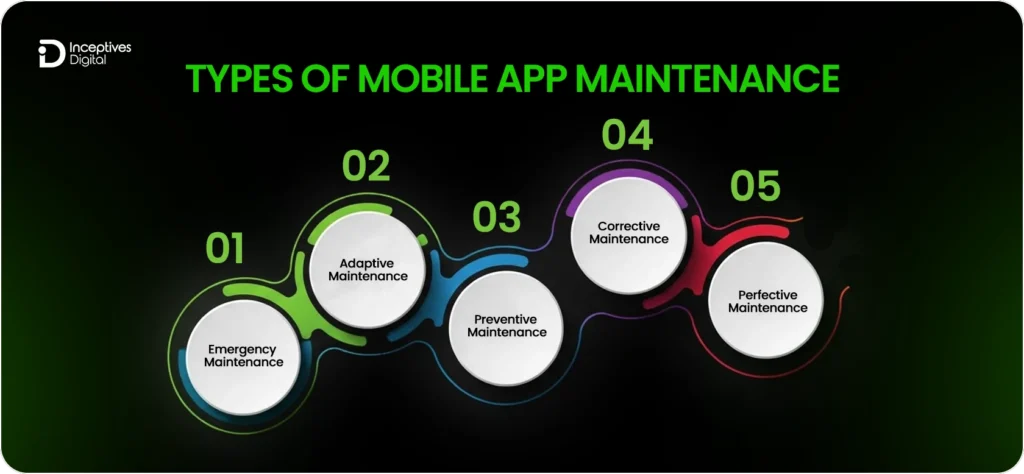
Maintenance is a layered process. It’s not just squashing the occasional bug; it’s about continuous adaptation and improvement within a rigid software development life cycle (SDLC).
- Corrective Maintenance (Bug Fixes and Production Issues): This is the closest, most reactive type of work: fixing the system when it crashes, fixing defects found in production, and handling issues reported by users. If development QA is strong, this should be a very small component.
- Adaptive Maintenance (OS Updates and Platform Changes): This is the main planned expense. It entails updating your codebase when Apple or Google releases a new OS version, introduces new APIs (like SwiftUI or Jetpack Compose updates), or changes the fundamental requirements (like background process limitations).
- Perfective Maintenance (Performance and UX Improvements): This is the ongoing refinement cycle. It includes resolving performance bottlenecks, upgrading code efficiency (for quicker build times), and simply making the system more usable as per the feedback of analytics.
- Preventive Maintenance (Reducing Technical Debt Over Time): This is very much a long-term, strategic decision. It consists of activities like proactively refactoring the old code, upgrading core library dependencies, changing the database indexing (for better query performance), and making the system stronger against failures before a crash is experienced.
- Emergency Maintenance (Critical Fixes and Security Incidents): It is a part of the unplanned, highest priority work that is usually caused by system outages, critical bugs, security vulnerabilities, or failures of third-party services. In most cases, emergency maintenance requires developers to be immediately available and is generally more costly due to the lack of time. The importance of proactive maintenance in reducing the occurrence of these situations.
The Platform Split Android vs iOS
Your choice of native platform instantly impacts maintenance effort due to platform-specific ecosystems and update strategies:
- Android app development often requires more extensive QA cycles. Why? Device fragmentation. You need to ensure your app behaves correctly across hundreds of distinct device/OS combinations, including custom OEM skins (like Samsung’s One UI). This leads to increased testing time using farm services like Firebase Test Lab, directly increasing the mobile app maintenance budget.
- iOS app development maintenance is usually faster on the QA side, but it is more deadline-driven. Apple’s yearly major OS releases are critical; you must update quickly for the new APIs and security protocols to ensure App Store compliance and avoid losing access to key features or user segments.
CTA SECTION START
cta title: Curious how these maintenance layers affect your budget?
cta des: Schedule a consultation to map your app’s maintenance plan.
cta button: Schedule Your Consultation
CTA SECTION END
How Mobile App Maintenance Costs Are Calculated: The 15-25% Rule
Let’s talk numbers and industry financial models. The benchmark for budgeting is a hard rule derived from years of project data:
You should budget 15% to 25% of your app’s initial development cost annually for maintenance.
This percentage covers all adaptive, corrective, perfective, and preventive work. If your app development team built a complex enterprise-grade application for $300,000, you should set aside $45,000 to $75,000 every year just to keep the lights on, the product competitive, and the codebase current.
A reliable mobile app development company will always bake this percentage into its long-term proposal, often structuring it as an annual retainer agreement to ensure resource stability.
Maintenance Pricing Models and Service Level Agreements (SLAs)
The chosen pricing structure directly affects your cost control and service quality.
| Model | Description | Cost Control & Resource Allocation | Best Fit for Your Project |
| Percentage Retainer | Fixed annual fee (based on 15-25% benchmark). Includes defined hours for proactive maintenance. | High predictability (OpEx). Guarantees dedicated resources and bandwidth for updates. | Long-term projects and established enterprises require stability and compliance. |
| Monthly Hourly Block | A fixed block of developer hours (e.g., 60-120 hours/month) for proactive and reactive work. Excess hours are billed at a premium. | Predictable monthly cost with flexibility for minor feature sprints. Requires close hour tracking. | Startups and growing apps need dedicated, flexible support and minor feature sprints. |
| Pay-as-You-Go | Hourly billing only when a critical issue arises or a specific update is requested. | Low fixed cost, but high risk of premium billing for emergency work. | Small utility apps or projects with extremely low risk tolerance and minimal integrations. Not recommended for critical business apps. |
Mobile App Maintenance Cost Breakdown by App Type
The complexity and nature of user engagement fundamentally determine ongoing maintenance costs. Different types of apps require different levels of support and operational resources, which affect the annual budget. Here’s an overview of maintenance considerations across common app categories:
1. Simple Utility Apps
Examples: Calculator, Weather, Note-taking apps
Simple apps in mobile development require minimal maintenance. Updates generally focus on OS compatibility, minor bug fixes, and basic performance optimization.
2. Mid-Market Apps
Examples: E-commerce, Social networking, Booking apps
Maintenance for these apps involves server hosting, database scaling, API updates, and periodic feature enhancements to support user growth and engagement.
3. Enterprise / FinTech / Mobile Game Apps
Examples: Banking apps, Trading platforms, and High-complexity mobile game development projects demand continuous maintenance. This includes cloud scaling, regulatory compliance, real-time updates, robust security measures, and, for games specifically, LiveOps, continuous content updates, seasonal events, and anti-cheat systems.
Quick Comparison of Maintenance Cost By App Type
| App Type | Examples | Primary Expense Drivers | Architectural Complexity | Estimated Annual Maintenance Cost (Post Year 1) |
| Simple Utility | Calculator, Weather, Notes | OS updates, basic hosting, minor bug fixes | Low | $5,000 – $15,000 |
| Mid-Market | E-commerce, Social, Booking | Database scaling, API updates, payment security, analytics | Moderate | $15,000 – $45,000 |
| Enterprise / FinTech / Mobile Game | Banking, Trading, Multiplayer Games | Cloud infrastructure, regulatory compliance, security, real-time updates, LiveOps for games | High | $45,000 – $150,000+ |
Key Technical Factors That Increase Mobile App Maintenance Costs
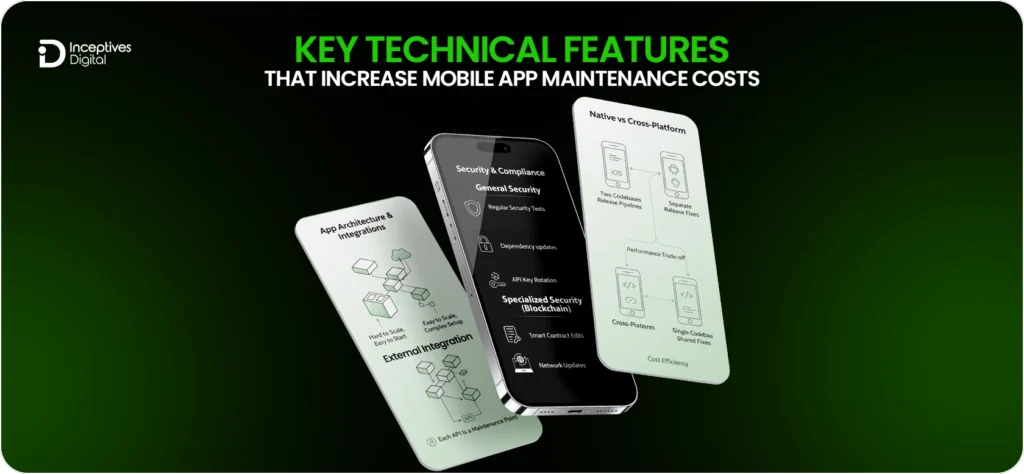
This is the technical core. These factors determine if your annual budget sits at the 15% low end or the 25% high end, impacting long-term operational costs.
1. Native vs Cross-Platform App Maintenance Cost Differences
This is a key architectural decision that defines your labor costs:
- Native Approach: You have two separate apps that you are updating, one developed for Android and the other for iOS. Consequently, the number of platform-specific bugs that you have to deal with has doubled, as you need two separate release pipelines, which increases the labor cost. This is a must for apps that need to have high performance (for instance, complicated 3D graphics, heavy device integration).
- Cross-Platform Approach: With the help of frameworks such as Flutter or React Native, cross-platform app development is possible from a single shared codebase. In this way, the need for maintenance is significantly reduced, since a single solution usually fixes the problem for both iOS and Android at the same time. Such a situation is perfect for content-heavy or utility apps.
2. How App Architecture Affects Long-Term Maintenance Cost
The way your app is engineered is the most important long-term cost factor.
- Monolithic vs. Microservices: Applications that follow complex custom development concepts, especially those that employ decoupled microservices, can be scaled with ease but are quite challenging to maintain at the initial stage and thus need specialized infrastructure-as-code (IaC) skills.
- External Integrations: Each third-party API (payment processors, CRM systems, authentication services) is a possible point where failure can occur. In case your application connects with five external services, then you have five different dependencies that demand flexible maintenance when the third party updates its API version.
3. Security and Compliance Costs in Mobile App Maintenance
Security isn’t a one-time feature; it’s a perpetual commitment driven by evolving threats.
- General Security: Set aside money for regular security tests, changing dependency packages (for example, Node.js, Django) to fix the vulnerabilities that are already known, and rotating API keys.
- Specialized Security (Blockchain): In case you have a decentralized system based on blockchain development, your upkeep is like a high-risk, price job that includes things such as occasional smart contract audits, cryptographic library updates, and compliance with network consensus upgrades (for instance, Ethereum hard forks). Usually, this kind of work needs a developer with a very specific and niche skill set.
CTA SECTION START
cta title: Want to lower long-term maintenance costs without compromising stability?
cta des: Talk to our team about smart architecture choices.
cta button: Lower Your Long-Term Costs
CTA SECTION END
Detailed Breakdown: Where Mobile App Maintenance Money Goes
To truly outperform the competition, you need to know exactly what services you’re paying for. This detailed breakdown accounts for the vast majority of the 15-25% annual app development budget.
Bug Fixes, QA, and Performance Optimization Costs
This covers the entire Quality Assurance (QA) lifecycle post-launch:
- Crash Monitoring and Analytics: Expenses associated with the purchase of licenses for tools (e.g., Firebase Crashlytics, Sentry) that record errors, which the maintenance team has to continually examine and manage.
- Memory Management: Fixing memory leaks, improving the use of background processes, and making sure that the battery consumption is efficient are very important for the retention of users on both Android and iOS.
- Continuous Integration/Continuous Deployment (CI/CD): The work of sustaining and upgrading the automated testing and deployment pipelines through which the releases are made rapidly and without errors.
OS Updates and Device Compatibility Testing Costs
This is the non-negotiable cost driven by the platform holders.
- Major OS Adaptation: Each major release of the OS requires a lengthy maintenance sprint, usually of several months, in order to adapt the UI, security permissions, and SDK features integration.
- Device Testing: A significant part of the budget for Android app development is allocated to the costs of device farms or cloud testing services that are used to confirm the compatibility of the app with different devices and operating system patches.
Cloud Infrastructure, Hosting, and Server Maintenance Costs
This is the recurring bill for running your application’s backend.
- Cloud Compute and Storage: The cost of running your virtual servers, serverless functions (Lambda/Cloud Functions), database storage, and file storage (S3/Cloud Storage). This scales linearly with user growth.
- Database Optimization: Regular efforts to improve database performance through indexing, query optimization, and possibly a step-wise migration to a more scalable database solution (for instance, a transition from Postgres to CockroachDB)
- Load Balancing and CDN: Using load balancers to handle traffic spikes and Content Delivery Networks (CDNs) for asset delivery are some of the activities being carried out to maintain the system and thus ensure uptime during periods of high demand (e.g., holiday sales, major product announcements).
Third-Party Tools, Licenses, and SaaS Subscription Costs
Every premium feature you use has a recurring charge:
- Payment processors (Stripe, Braintree)
- Map services (Google Maps API, Mapbox)
- Analytics and Push Notifications (Firebase, OneSignal)
- Compliance tools (for GDPR, HIPAA, etc.)
The Budget Separation Enhancements vs Maintenance
One of the most important things that you need to do with your app development partner is to define clear Service Level Agreements (SLAs). Firstly, you need to separate maintenance tasks (fixing, adapting, preserving) from feature expansion tasks (new modules, major UI redesigns) very clearly. If you do not separate these budgets, you will have the danger of your stability budget, which is supposed to be used for fixing the issue, being eaten up by feature requests that have not been planned.
Hidden Mobile App Maintenance Costs Most Businesses Miss
These costs are those that are usually ignored when the initial planning phase is carried out, especially the ones that are related to a hurried custom software development:
- Technical Debt and Legacy Code Refactoring Costs: Paying to rewrite code that was poorly written, not documented, and came from the original build. If the code is such that it is hard for the new developers to understand, then you have a huge technical debt, and the price for new features goes up drastically.
- Emergency Security Patch and Zero-Day Vulnerability Costs: The expense of emergency developer time (often billed at a 1.5x or 2x premium) required to fix a sudden, critical security flaw that compromises user data. This demands an immediate, unscheduled budget allocation.
- Developer Turnover and Codebase Knowledge Transfer Costs: If your original development team leaves, the time required for a new app development company to learn and document the existing codebase (the “ramp-up” phase) is a high, hidden cost you pay hourly.
- Compliance Fines and Regulatory Risk Costs: Fines and legal fees resulting from failure to adapt to evolving regulations (e.g., not updating privacy policies for GDPR/CCPA, or failing to meet HIPAA compliance standards).
How to Reduce Mobile App Maintenance Costs Without Risk
You can cut costs without sacrificing stability, it just requires smarter architectural choices upfront and continuous optimization.
- Using Cross-Platform App Development to Lower Costs: For non-performance-critical apps, using frameworks like Flutter or React Native is the most effective way to reduce the overall effort required for Android and iOS updates by reducing codebase management.
- Automating Testing and CI/CD to Reduce Maintenance Effort: Automating unit, integration, and UI tests reduces the time spent on manual QA after every update, dramatically lowering recurring labor costs. This investment pays for itself within the first year.
- Choosing the Right Mobile App Maintenance Partner: Resist the urge to switch vendors frequently. Experienced mobile app developers who already possess intimate knowledge of your codebase can execute maintenance tasks 30-50% faster than a new, ramping-up team.
- Using Managed Cloud Services to Control Infrastructure Costs: Leverage your cloud provider (AWS RDS, Google Cloud Functions) to handle tasks like operating system patching, database backups, and server maintenance, offloading critical but repetitive labor costs from your development team.
When Mobile App Maintenance Becomes New Development
Sometimes, you reach a point where fixing or updating the old app is more expensive, risky, or architecturally unsound than starting fresh. This transition, often called a re-platforming or major redesign, is essentially a new software development cycle.
This shift is triggered by factors like:
- Signs Your App Needs a Complete Rebuild: The original framework (e.g., old versions of AngularJS, Swift 2) is no longer supported, making security updates impossible.
- When Technical Debt Makes Maintenance Too Expensive: The company launches massive new modules (e.g., adding a B2B SaaS portal to a B2C app) that cannot be integrated into the existing monolithic architecture.
- Re-Platforming vs Continuous Maintenance Decisions: The code has accumulated so much debt that every new feature takes longer to build and introduces more bugs than the feature before it, justifying a complete, structured rebuild.
Final Thoughts: Budgeting Mobile App Maintenance for Long-Term Success
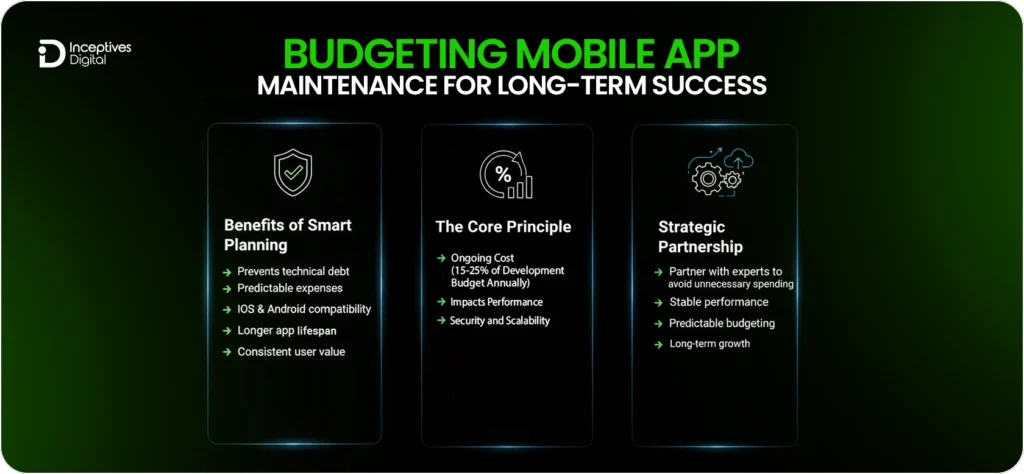
Mobile app maintenance is not a one-time task but an ongoing cost that directly impacts performance, security, and scalability. Planning and allocating 15–25% of your mobile app development cost annually helps prevent technical debt, control long-term expenses, and keep your app compatible with evolving iOS and Android updates. A well-maintained app lasts longer, performs better, and delivers consistent value to users.
If you’re building a new app or reassessing your mobile app maintenance costs, partnering with an experienced app development company can help you plan smarter and avoid unnecessary spending. A strategic maintenance approach ensures stable performance, predictable budgeting, and long-term growth. Contact us to get expert guidance now to create a maintenance plan that fits your product and business goals.
CTA SECTION START
cta title: Take control of your app’s performance and budget
cta des: Get expert guidance today and secure a long-term maintenance plan tailored to your app.
cta button: Get Expert Guidance Today
CTA SECTION END
Mobile App Maintenance Cost FAQs
Mobile app maintenance costs in the USA typically range from 15% to 25% of the initial development cost, annually. Due to high U.S. labor rates (up to $250/hour), a software development project costing $200,000 to build may require an annual budget of $30,000 to $50,000 for ongoing support and compliance.
No, it is not. The initial development cost covers the capital expense (CapEx) to build the app. Mobile app maintenance is a separate, recurring operational expense (OpEx). After the brief warranty period, a separate annual retainer agreement or SLA (Service Level Agreement) is required for long-term adaptive and corrective work.
Android app development often costs slightly more to maintain. While iOS app development requires intense effort for major OS updates, the overall cost for Android is driven up by mandatory fragmentation testing across numerous devices and OEM skins, requiring more continuous QA labor time.
Yes, and it is standard practice. Outsourcing maintenance to a specialized mobile app development partner converts high fixed internal labor costs into a predictable OpEx. This also grants access to specialized talent (e.g., cloud engineers, blockchain app development experts) and ensures faster response times for critical issues.
App maintenance lasts for the entire operational life of the product. As long as your app is live and used by customers, maintenance is mandatory. Continuous adaptation to new OS versions, security patching, and third-party API changes ensures the app remains stable and compliant.
SIDEBAR LIST START
- What Is the Cost of Mobile App Maintenance? A Complete Budget Breakdown
- Mobile App Development Cost A Blind Spot for New Apps
- What Is Mobile App Maintenance? A Technical and Business Definition
- How Mobile App Maintenance Costs Are Calculated: The 15-25% Rule
- Mobile App Maintenance Cost Breakdown by App Type
- Key Technical Factors That Increase Mobile App Maintenance Costs
- Detailed Breakdown: Where Mobile App Maintenance Money Goes
- Hidden Mobile App Maintenance Costs Most Businesses Miss
- How to Reduce Mobile App Maintenance Costs Without Risk
- When Mobile App Maintenance Becomes New Development
- Final Thoughts: Budgeting Mobile App Maintenance for Long-Term Success
- Mobile App Maintenance Cost FAQs
SIDEBAR LIST END